To operate legally in Mainland China, every business must have a valid business license. This document confirms that your company is officially registered and authorized to conduct specific commercial activities. It includes key details like your company’s legal name, business scope, registered capital, and date of incorporation.
While the process may seem complex at first, breaking it into steps makes it easier to manage, especially with the right guidance.
That’s what this guide is about.
What is a Business License in China?
A business license is the document that confirms a company is allowed to trade in China. It’s issued by the Administration for Market Regulation (SAMR) and confirms your company’s legal identity and authorization to operate.
Definition
The business license is governed by laws like the Company Law of the People’s Republic of China. You need it to open a bank account, apply for tax registration, sign contracts, and conduct other core business functions. It also signals your company’s legitimacy, which helps build trust with customers, partners, and regulators.
Components of a China Business License
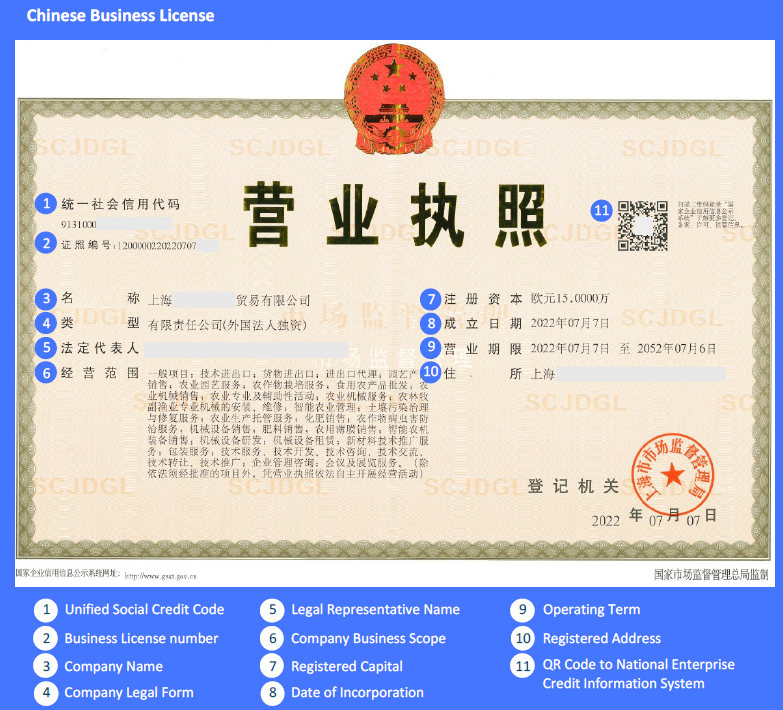
Description of a China Business License
A standard Chinese business license includes:
Field | Description |
Unified Social Credit Code | An 18-digit company ID used across all government systems |
Business License Number | The license document number |
Company Name | Official registered name |
Company Legal Form | Type of legal entity (e.g., limited liability company) |
Legal Representative | Person legally accountable for the company |
Business Scope | List of approved business activities |
Registered Capital | Declared capital contributed by shareholders |
Date of Incorporation | Company’s official establishment date |
Operating Term | Timeframe the business is allowed to operate |
Registered Address | Official business location |
QR Code | Link to the company’s public record in the national database |
Registration Process for a China Business License
Setting up a company in China involves several steps, including planning, application, and post-registration procedures. Here’s a breakdown.
Pre-Registration Requirements
You need a verified physical office address in China. Virtual offices may not be accepted unless approved by local authorities.
You’ll also need to choose a compliant company name and define your business scope. The business scope outlines your company’s permitted activities. It must be accurate, as modifying it later requires additional review and approval.
Regulatory Bodies Implication
The primary agency is the SAMR, which manages name approval, license issuance, and company records.
Other relevant entities include the local tax bureau, social security offices, and the National Enterprise Credit Information Publicity System. These departments ensure that your company is registered across all required government databases.
Steps for Completing Company Registration
- Complete Pre-Registration Tasks: Confirm your business address, prepare required documents, and decide on your legal structure and business scope.
- Submit Your Application: File your application with the local SAMR office. You’ll declare your registered capital, which appears on your license and reflects the company’s financial standing.
- Appoint a Legal Representative: This person is legally responsible for the company’s actions and must be listed on the license. For foreign investors, this is often a senior executive or board member.
- Obtain the 5-in-1 Business License: After approval, you’ll receive a unified certificate that consolidates registration for business, tax, social security, and statistics.
- Complete Filing Requirements: While some cities offer online registration, foreign-owned businesses may still need to submit documents in person or provide notarized copies.
Types of Business Entities in China
Foreign businesses must choose a structure that fits their objectives and risk appetite. These are the main types available to overseas founders:
Wholly Foreign-Owned Enterprises (WFOEs)
A WFOE is fully owned and operated by foreign individuals or companies. It offers full control over operations, HR, and profits.
WFOEs are popular in sectors like tech, consulting, trading, and manufacturing. They allow direct invoicing and revenue generation but require more documentation and compliance steps during setup.
Find out more about WFOEs here.
For more information on a China WFOE, visit our resource page and request a FREE copy of the white paper.
Joint Ventures
Joint Ventures (JVs) are partnerships between foreign and Chinese entities. They’re often used in regulated sectors or when local resources are key to success.
There are two forms:
- Equity Joint Ventures (EJV): Profit and risk are shared based on ownership percentage.
- Cooperative Joint Ventures (CJV): Rights and responsibilities are set by agreement.
JVs offer access to local networks but come with added complexity in governance and profit sharing.
Learn more about a JV and how it works through our FREE Joint Venture white paper.
Representative Offices
ROs are suitable for companies testing the Chinese market. They’re not allowed to generate revenue or issue invoices, but can manage tasks like sourcing, liaison work, and research.
Read our Representative Office Guide
Partnerships and Sole Proprietorships
A foreigner can either form a partnership with a Chinese national/entity or operate as a sole proprietor.
Operating a Business in China
Beyond registration, running a business in China entails ongoing responsibilities, including tax filing, legal compliance, and digital operations. Understanding each area helps companies to stay compliant.
Tax Obligations and Compliance
Once registered, every business in China must obtain a Tax Identification Number (TIN) and regularly file taxes. This includes monthly, quarterly, and annual filings with the local tax bureau.
Key taxes include:
- Value-Added Tax (VAT)
- Corporate Income Tax
- Other applicable industry or location-specific taxes
It’s strongly recommended to hire a local accountant familiar with Chinese tax rules and reporting systems to manage filings, avoid penalties, and stay ahead of regulatory changes.
Bank and Financial Considerations
Opening a Chinese bank account is essential for operations. You’ll usually need:
- An RMB account for daily local transactions
- A foreign currency account for cross-border business
To open a bank account, provide documents like your business license, company stamps, and identification for the legal representative, who often must appear in person.
Legal and Contractual Compliance
Staying legally compliant means keeping your license current and using the right legal processes.
Key requirements:
- Your business must have the correct license for its specific activities.
- All contracts must be stamped using your registered company seal. In China, a stamped contract is often more critical than a signature.
- Keep your company records updated and renew licenses before they expire.
- Register trademarks and intellectual property early to protect your brand from infringement.
Digital Compliance and Online Operations
If your business runs a website targeting Chinese users, you’ll need an ICP license (Internet Content Provider). This is a legal requirement for hosting a website on Chinese servers.
You also need to:
- Complete real-name verification for online activities
- Follow data privacy rules under China’s cybersecurity law
- Keep a digital audit trail for online sales and customer interactions
- Stay within your approved business scope, especially if selling products or services online
Unique Requirements for Business Licenses
Some business license requirements vary based on your location or industry. Staying aware of these specifics is key to avoiding delays and ensuring long-term viability.
Region-Specific Regulations
Cities like Shanghai, Beijing, and Shenzhen may offer different incentives, restrictions, or application procedures.
Some cities also allow pilot programs for innovative industries, which may speed up your approval timeline.
Choosing the right city can affect taxes, talent access, and permit availability.
Industry-Specific Licenses
Certain sectors, like finance, healthcare, education, and media, require special licenses in addition to a standard business license.
For example, Healthcare companies must get approval from the National Health Commission
Creative businesses should also ensure IPR (Intellectual Property Rights) and copyright protections are in place.
Technological Advancements and Their Impact
China’s digital transformation has modernized the business licensing process.
The SAMR now offers electronic licenses, making it easier to apply and manage company data. Online systems speed up registration and renewal, and reduce paperwork.
Tools like online verifications and digital seals also help verify company legitimacy and streamline remote approvals.
Renewal and Changes to the Business License
Your business license is not indefinite. To stay in good legal standing, keep track of renewal deadlines and report major changes promptly.
Understanding the Renewal Process
Licenses expire based on the terms set during registration. Businesses must initiate the renewal process in advance, or risk suspension or fines.
To renew:
- Prepare updated documents
- Ensure all filings are up-to-date
- Confirm that records match those in the government’s system
Managing Changes in Company Information
The following changes must be reported to the SAMR:
- Business Scope
- Registered Address
- Legal Representative
- Company Type
These updates often require:
- A formal application
- Supporting documents like board resolutions
- Updated leases or contracts
- Proof of the new legal representative’s identity (if applicable)
Once approved, your business license must be reissued to reflect these updates.
Verifying the Authenticity of a China Business License
Before engaging with any Chinese business, it’s vital to confirm that their business license is genuine. Authenticity can be verified by checking the license details through official government platforms or using a trusted verification service.
Leveraging the Business License for Growth
A business license in China is more than a registration formality. It’s a strategic tool that unlocks market access, validates your legitimacy, and enables operational scaling. Here’s how to do it:
Expanding Business Scope and Market
Every license in China outlines a specific business scope, the set of activities your company is legally allowed to conduct. By adjusting this scope, businesses can branch into new services or markets as they grow.
Your license also reflects key operational indicators like registered capital and business type.
Failing to align your actual activities with your approved scope can lead to penalties or shutdowns.
Using the License in Marketing and Branding
Displaying your business license reinforces your legitimacy in the eyes of customers and partners. You can include your license number, registration date, and Unified Social Credit Code (USCC) on websites or promotional materials to signal transparency.
You can also tie your license details into your brand story, emphasizing your legal setup, registered capital, and the regulatory authorities you comply with.
Challenges and Solutions for Business Licensing
Navigating China’s business licensing system can be complex, especially for overseas entrepreneurs.
Common Pitfalls and Legal Challenges
Common issues include:
- Misunderstanding business scope limitations
- Submitting incomplete or inconsistent application documents
- Overlooking post-registration compliance (e.g., tax setup or renewal deadlines)
The multilayered licensing structure adds complexity. Delays are common without proper planning, and non-compliance can result in administrative penalties or loss of license.
Avoiding these issues requires strong compliance systems and a clear understanding of local regulatory expectations.
Professional Support and Advisory Services
MSA provides full-service support for business registration and licensing in China, from securing your initial business license to setting up your company seal and opening a bank account.
Our local experts help you:
- Select the correct business scope
- Compile and review application documents
- Navigate city-specific rules
- Maintain compliance after registration
We also support change registrations and renewals, saving you from potential disruptions. Contact us for more information.
Additional Licenses and Registrations
A standard China business license is just the first step. Many companies need additional registrations or permits to operate legally in specific sectors or to meet ongoing compliance standards.
Tax Registrations and Certifications
After receiving a business license, every company must register with the local tax bureau. This links your entity to its Unified Social Credit Number.
Key requirements include:
- Registering for VAT
- Setting up for CIT
- Complying with employees’ individual income tax
You’ll also need to issue fapiao (official invoices), maintain proper accounting records, and file monthly, quarterly, and annual tax returns.
Operational and Sector-Specific Permits
Some industries require extra regulatory approval. If your business operates in sectors like finance, education, and healthcare, you will need sector-specific licenses issued by the government.
Staying compliant means not only obtaining these permits initially, but also renewing them on time and updating them as your business changes.
Every business in mainland China must obtain a business license before operating, and the unified five-in-one license now consolidates multiple registrations into a single application. MSA Asia’s China company formation experts guide you through the full license process, from scope definition to approval. Reach out to start your application.

 General Guides
 Regional Guides
 Starter Guides