 General Guides
 Regional Guides
 Starter Guides

A common pattern we see in 2026: a foreign founder lands in Hangzhou because of DeepSeek, Unitree, or one of the other “Six Little Dragons”, picks a CBD address in Shangcheng for the lifestyle, then realises after the first tax filing that the AI-talent network is in Yuhang, the cross-border e-commerce regime is in Xiaoshan, and the HNTE 15% rate they were quietly counting on is harder to claim from a downtown sub-bureau than from Binjiang. Hangzhou company registration rewards founders who pick the district for the policy fit first and let lifestyle follow.
Hangzhou is no longer just the Alibaba city. The Six Little Dragons — DeepSeek, Unitree, Game Science (Black Myth: Wukong), BrainCo, Manycore, and Deep Robotics — reshaped the city’s reputation through 2024 and 2025. Hangzhou’s Future Industries Development Plan (2025–2026) has formalised AI, robotics, and synthetic biology as the next pillars after e-commerce.[1] The city allocates roughly 15 percent of its annual fiscal revenue to tech investment and R&D subsidies, the highest share of any provincial capital.
This guide is written for foreign founders, COOs, and expansion leads working out whether Hangzhou is the right city, which entity to pick, and how long registration will really take in 2026. It covers the four entity options, the step-by-step process, district choice, the registered capital reality, and the most expensive mistakes we see foreign investors repeat. If you’re still mapping the broader entity decision, our WFOE registration in China service page covers the national framework. This article zooms in on Hangzhou.
Why register a company in Hangzhou?
Three things make Hangzhou worth a serious look against Shanghai and Shenzhen.
The first is the digital-economy regulatory infrastructure. The China (Zhejiang) Pilot Free Trade Zone Hangzhou Area covers 37.51 square kilometres and carries an explicit brief as a digital-economy demonstration zone and cross-border e-commerce demonstration centre.[2] Hangzhou hosts China’s first Cross-border E-commerce Comprehensive Pilot Zone, established in March 2015. The regulatory experiments — bonded warehousing, simplified customs, e-CNY pilots — run here first before they roll out nationally. If your model is direct-to-consumer cross-border, Hangzhou has the deepest operational stack in China.
The second is the talent cluster. Yuhang’s Future Sci-Tech City concentrates Alibaba, Ant Group, and Cainiao alongside the Six Little Dragons. The talent pool for AI engineers and full-stack developers in Hangzhou now rivals Beijing’s Haidian — at materially lower compensation expectations and significantly lower commercial rents. For foreign AI, biotech, or hardware-software founders, Hangzhou has gone from “interesting alternative” to “credible primary choice” in 18 months.
The third is cost efficiency. Grade-A office rents in Hangzhou run roughly 30–40 percent below Shanghai, engineering compensation tracks 15–25 percent below Tier-1 cities, and the HNTE 15% CIT route is reliable in Yuhang and Binjiang. For a research-heavy or back-office operation that needs scale without coastal-city cost structures, Hangzhou is increasingly the answer.
If you’ve already decided the city is right and want to compare directly with our other Tier-1 hubs, our Shanghai, Beijing, Shenzhen, Guangzhou, Xiamen, Chengdu, and Hainan company registration guides break down the same trade-offs.
Four entity options for foreign investors in Hangzhou
Most foreign companies skip this comparison and default to a WFOE. That’s right about 80% of the time. The other 20% is where the cost of getting it wrong is highest, so it’s worth twenty minutes of thinking.
WFOE — Wholly Foreign-Owned Enterprise
The default. A WFOE is a Chinese limited liability company owned 100% by foreign shareholders, with no local partner required. You keep full control of HR, operations, IP, and profit repatriation. Three sub-types matter for Hangzhou: consulting/services WFOE, trading or e-commerce WFOE (needs customs registration on top), and manufacturing WFOE (needs an environmental impact assessment).
Our WFOE in Hangzhou deep-dive walks through scope wording, sector restrictions, and the Hangzhou FTZ digital-economy pilots.
Joint Venture (EJV or CJV)
You only need a JV when the negative list forces equity-sharing with a Chinese partner.[3] That’s typically restricted sectors like telecom (legacy categories), some publishing, parts of healthcare and education, and a few others. The 2024 negative list keeps shrinking. If your sector is open to a WFOE, going JV “for relationships” is almost always a worse deal than people assume.
For the legal mechanics, see our joint venture in China page.
Representative Office (RO)
A Hangzhou rep office can do market research, liaison work, and brand promotion. It can’t sign contracts, invoice clients, or hire Chinese staff directly. Staff must be dispatched through an authorised agency. ROs are taxed on a deemed-profit basis even though they don’t sell, which catches many parents off guard. Use a representative office only when you genuinely don’t need to trade in China yet.
Branch Office
A branch is an extension of the foreign parent rather than a separate Chinese legal person. It’s faster to set up but exposes the parent to Chinese liabilities directly. Branches mostly appear in financial services and a few professional service exemptions. The mechanics live on our setting up a branch office in China page.
Quick comparison
| Aspect | WFOE | JV | RO | Branch |
|---|---|---|---|---|
| Foreign ownership | 100% | Negotiated | 100% (parent) | 100% (parent) |
| Can sign Chinese contracts | Yes | Yes | No | Yes |
| Can invoice clients | Yes | Yes | No | Yes |
| Can hire staff directly | Yes | Yes | No (via dispatch) | Yes |
| Statutory minimum capital | None | Negotiated | None | N/A |
| Setup time (Hangzhou, service) | 5–7 weeks | 9–13 weeks | 4–6 weeks | 4–6 weeks |
| Eligible for cross-border e-commerce regime | Yes (in Xiaoshan, scope-dependent) | Yes (scope-dependent) | No | No |
| Parent liability shield | Yes | Yes | No | No |
Step-by-step Hangzhou company registration process
The national framework is the 2024 revised Company Law plus the Foreign Investment Law. Hangzhou layers its own service flow underneath. Here’s the realistic sequence for a service WFOE.
1. Reserve the company name (1–3 working days). Submit three Chinese name options to Hangzhou SAMR. Names are reserved for six months and can be extended once. Common rejection reasons: industry-keyword conflicts and characters that overlap with state-owned enterprises.
2. Notarise and Apostille shareholder documents abroad (1–3 weeks, in parallel). Since China joined the HCCH Apostille Convention in November 2023, the old double-legalisation flow has been replaced by a single Apostille certificate for member-country shareholders. For non-member countries, the legacy notarisation plus Chinese consulate authentication still applies.
3. Lock in a compliant Hangzhou office address. Hangzhou SAMR sub-bureaus require a verifiable 25-digit property real estate code on the lease, and shared or virtual addresses are mostly blocked. Xiaoshan is one place where this gets easier for cross-border e-commerce filings — the Hangzhou Cross-border E-commerce Pilot Zone has approved bonded-warehouse and FTZ-linked address structures.
4. Submit the registration package to Hangzhou SAMR (5–10 working days). That includes Articles of Association in Chinese, business scope wording, legal-representative ID, registered-capital declaration, and the lease.
5. Receive the Business Licence (营业执照). This is the single document that proves the company exists. Carve five official seals (company chop, finance chop, contract chop, invoice chop, and legal-representative chop) at a SAMR-licensed engraver.
6. Tax-bureau registration. Within 30 days. Hangzhou’s State Taxation Administration assigns a tax officer and decides whether you start as a small-scale taxpayer or apply for general taxpayer status. Yuhang and Binjiang are the most experienced sub-bureaus for HNTE applications.
7. Open RMB and foreign-currency capital accounts. Bank of China, ICBC, China Merchants, HSBC China, and Standard Chartered China are the most foreign-friendly in Hangzhou. In-person ID verification of the legal representative is mandatory at most Hangzhou banks, and the finance manager is sometimes also asked to attend. Plan for at least one in-person trip even if the SAMR side is fully remote. Expect 2–4 weeks.
8. SAFE registration for cross-border capital. State Administration of Foreign Exchange must register the company before any registered capital can be wired in.
9. Inject registered capital within five years. Article 47 of the 2024 Company Law requires paid-in capital within five years of registration.
Realistic total for a Hangzhou service WFOE in 2026: 5–7 weeks from name pre-approval to a usable bank account, with the bank account being the binding constraint because of the in-person verification requirement. Trading and e-commerce WFOEs add 2–4 weeks for customs registration, manufacturing WFOEs add 4–8 weeks for environmental impact assessment.
Choosing your Hangzhou district for company registration
District choice in Hangzhou is functional, not aesthetic. Each district has a specialism, a tax authority you’ll deal with for years, and an enforcement style that affects HNTE applications and FTZ alignment.
| District / Zone | Best suited to | Key advantage | Watch-outs |
|---|---|---|---|
| Yuhang (Future Sci-Tech City) | AI, robotics, synthetic biology, e-commerce HQs; Six Little Dragons cluster | Densest concentration of AI and engineering talent outside Beijing; co-location with Alibaba, Ant Group, Cainiao; Future Industries Plan subsidies | Commercial rents rising; office stock concentrated in a few campuses; commute from central Hangzhou is long |
| Binjiang (Hi-Tech Industrial Development Zone) | Hardware, IoT, fintech, mid-stage tech; HNTE-friendly | National-level hi-tech zone; HNTE 15% CIT route works reliably; mature foreign-investor track record | Less concentrated talent network than Yuhang; finance ecosystem thinner than Shanghai |
| Xiaoshan (Hangzhou Cross-border E-commerce Pilot Zone + FTZ Hangzhou Area) | Cross-border e-commerce, bonded warehousing, logistics, brand operations | Most mature cross-border e-commerce regime in China (since March 2015); bonded warehouse access; airport-adjacent logistics | Industrial focus; service businesses without an e-commerce angle don’t benefit from the zone advantage |
| Shangcheng (downtown / West Lake-adjacent) | Professional services, consulting, finance, foreign HQs | Hangzhou’s historical CBD; closest to Hangzhou Xiaoshan International Airport for short hops; foreign-friendly services district | Tourism overlay during peak season; rent premium for West Lake-adjacent addresses |
| Xihu (Lakefront, around Zhejiang University) | Education-tech, R&D, professional services | Zhejiang University talent pipeline; clean, lower-density working environment; HNTE applications viable | Smaller commercial inventory; not a natural fit for industrial scale |
A rough rule of thumb: AI, robotics and tech R&D → Yuhang; hardware and HNTE → Binjiang; cross-border e-commerce → Xiaoshan; finance and professional services → Shangcheng; education-tech and university-adjacent R&D → Xihu. Get this wrong and you’re stuck with a sub-optimal tax authority and weak ecosystem fit for as long as the company exists, because re-registration in another district means dissolving and starting over.
Required documents for Hangzhou company registration
For the foreign corporate shareholder:
- Certificate of incorporation (Apostilled for HCCH-member countries; notarised plus Chinese consulate authenticated for non-members)
- Articles of association
- Director and signing authority list
- Most recent audited financial statements (sometimes requested)
For the legal representative and supervisor:
- Passport copies (notarised if signing remotely)
- CV (sometimes requested for sensitive sectors)
- In-person availability for the bank account opening (not legally mandated but operationally near-mandatory in Hangzhou)
Local Hangzhou-specific:
- Lease contract showing the 25-digit property real estate code
- Articles of Association of the new Hangzhou company in Chinese
- Business scope wording in Chinese — for Xiaoshan e-commerce filings, scope must include “cross-border e-commerce retail”, “bonded warehousing”, or “import and export trade” as applicable
- Capital contribution declaration
Registered capital and costs
There’s no statutory minimum registered capital for a consulting, services, or hi-tech WFOE in Hangzhou under the 2024 Company Law. Trading, e-commerce, and manufacturing WFOEs are also no-minimum on paper. What matters is the substance test: Hangzhou SAMR will refuse a registration where declared capital is obviously inadequate for the business scope, and the 5-year paid-in deadline (Article 47) means whatever capital you declare is now a binding obligation.
Realistic capital benchmarks Hangzhou SAMR will typically accept in 2026:
- Consulting / professional services: USD 50,000 – 150,000
- Tech / SaaS / AI: USD 100,000 – 500,000
- Cross-border e-commerce / trading: USD 150,000 – 500,000
- Manufacturing with EIA: USD 500,000+
For a national view on capital sizing, see our minimum registered capital for a WFOE in China guide.
The cost stack:
- Government registration fees are nominal, typically under RMB 1,000.
- Professional incorporation services run USD 2,500 to 5,500 in Hangzhou depending on entity type, district, and corporate-structure complexity.
- Office lease and deposit typically requires 3 months’ rent up front. Yuhang and Binjiang Grade-A space prices have risen sharply through 2025.
- Notarisation, Apostille, and translation runs USD 1,500 to 4,000 depending on origin country.
- First-year tax compliance runs RMB 25,000 to 60,000 depending on transaction volume.
Common Hangzhou company registration pitfalls (and how MSA helps)
A few things go wrong often enough that we treat them as standard risk items on every Hangzhou engagement.
E-commerce scope wording too narrow. Cross-border e-commerce in Xiaoshan requires specific scope wording. “Import and export trade”, “bonded warehousing”, and “cross-border e-commerce retail” all need to appear correctly. Generic “trading” wording locks you out of the simplified customs regime. Get the wording right at registration; amendments are slow.
HNTE applied for outside Yuhang or Binjiang. HNTE 15% CIT applications process most reliably in Yuhang and Binjiang because the local tax authorities see them constantly. R&D groups that register in Shangcheng or Xihu for convenience often spend longer on the application and face more scrutiny. Pick the district with the right tax-authority experience.
Underestimating the bank in-person requirement. Most Hangzhou banks require in-person ID verification of the legal representative — and sometimes the finance manager — to open the foreign-currency capital account. Founders who plan everything remotely are surprised when the bank-account step blocks SAFE registration and the whole timeline slides.
AI and data compliance. AI WFOEs in Hangzhou need to plan for the Generative AI Service Management Measures (effective August 2023) and the data-export security assessment regime. The pilots in the Hangzhou FTZ help, but they apply only inside the zone. Plan compliance before launch, not after the first regulatory check.
General taxpayer status not auto-granted. New WFOEs default to small-scale taxpayer status. If your buyers are large Chinese companies, they’ll want VAT special invoices, which require general taxpayer status. That’s a separate application that takes 4–8 weeks. Plan for it during registration.
Hangzhou versus Shanghai versus Shenzhen
Hangzhou wins on AI/robotics talent depth, cross-border e-commerce regulatory infrastructure, and cost efficiency for tech R&D. Shanghai wins on financial services and trading WFOEs that need the Pudong-Lingang FTZ regime. Shenzhen wins on hardware supply chain and Hong Kong integration via Qianhai. If your business is AI, biotech, or cross-border e-commerce, Hangzhou competes head-on with Shenzhen and increasingly wins on cost. For finance or trading at scale, Shanghai is still the right answer.
Key takeaways
Hangzhou rewards foreign investors who pick the right entity type, register in the right district, and plan ahead for the in-person bank verification step. The legal framework is mostly national, but Hangzhou’s enforcement style, the FTZ digital-economy pilots, and the in-person bank requirement make execution different from Beijing or Shanghai.
Five things to lock in before you submit your Hangzhou company registration application:
- Entity type. WFOE for 80% of cases. JV only when forced. RO and Branch are niche.
- District. Yuhang for AI and the Six Little Dragons cluster, Binjiang for hardware and HNTE, Xiaoshan for cross-border e-commerce, Shangcheng for services, Xihu for university-adjacent R&D.
- Address. A real lease with a 25-digit property real-estate code; FTZ-linked addresses for cross-border e-commerce.
- Capital. No statutory minimum, but size it for your scope and the 5-year paid-in rule.
- Bank logistics. Plan for the legal rep (and possibly the finance manager) to be in Hangzhou in person for at least one week.
If any of those five feel unresolved, that’s the conversation worth having before you spend money on notarisation. Book a discovery call with MSA’s Hangzhou team and we’ll work through your specific structure, district, and timeline.
For complementary reading: our WFOE in Hangzhou deep-dive on the Yuhang and Six Little Dragons cluster, the broader China company registration service overview, and our Beijing company registration and Shenzhen company registration guides for capital and district comparisons.
About the author
Harm Hoonstra is part of the MSA Asia partner team and works with foreign-invested enterprises on registration, tax, and structuring across mainland China.
Frequently asked questions about Hangzhou company registration
Can I own 100% of my Hangzhou company as a foreigner?
Do I qualify for the Hangzhou cross-border e-commerce regime?
How much registered capital do I need for a Hangzhou WFOE?
Can I use a virtual office in Hangzhou?
Why do I need to be in Hangzhou in person?
How long does Hangzhou company registration take in 2026?
Which Hangzhou district has the best HNTE process?
Is Alibaba ecosystem access a real advantage?
- Hangzhou Future Industries Development Plan (2025–2026), Hangzhou Municipal People’s Government. hangzhou.gov.cn, accessed April 2026.
- China (Zhejiang) Pilot Free Trade Zone — Hangzhou Area, 37.51 km² digital-economy demonstration zone; Hangzhou Cross-border E-commerce Comprehensive Pilot Zone (established March 2015). kjm.hangzhou.gov.cn, accessed April 2026.
- Ministry of Commerce of the People’s Republic of China. Special Administrative Measures (Negative List) for Foreign Investment Access, latest version published 2024. english.mofcom.gov.cn.
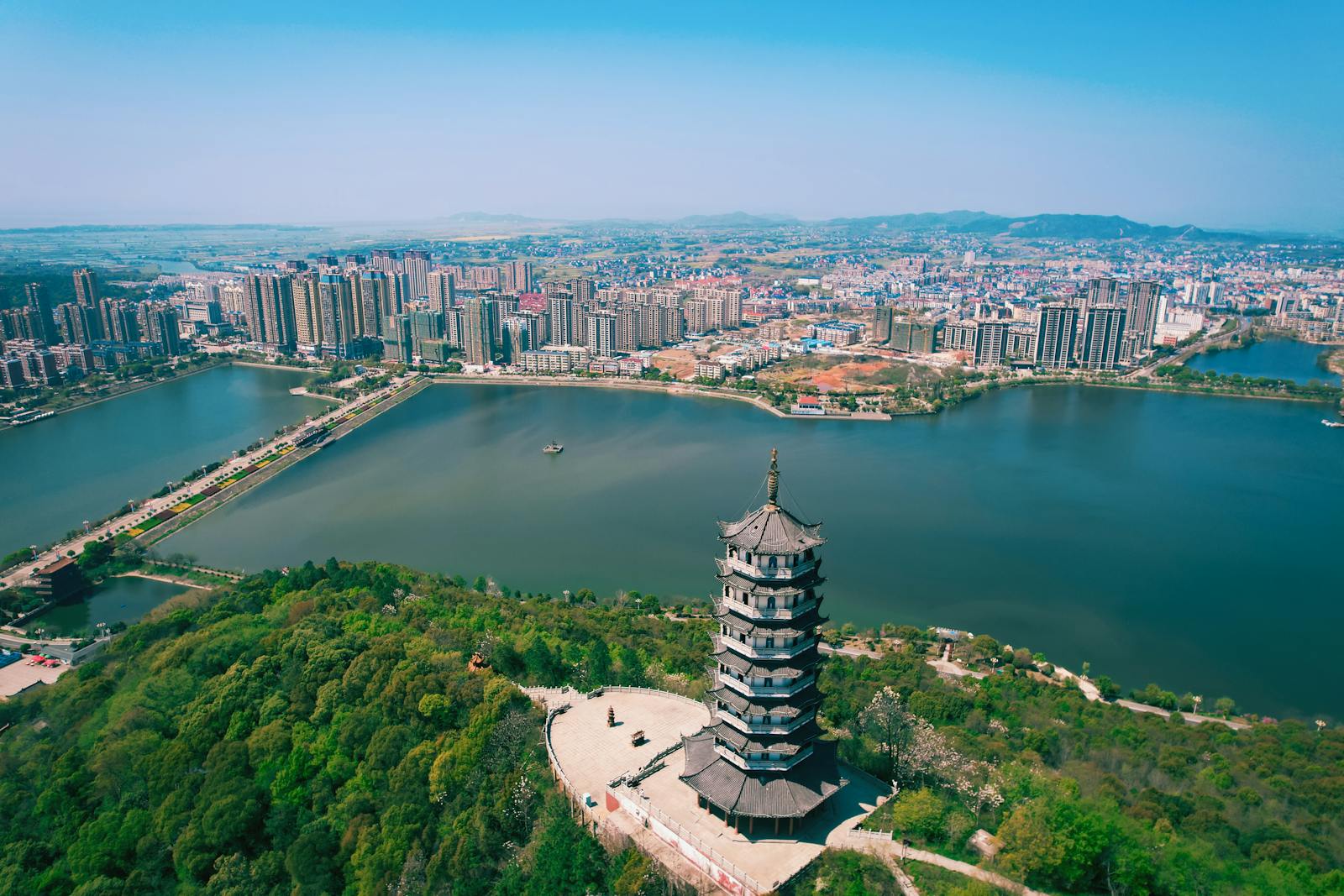
Foreign investors looking to open a company in China often choose Hangzhou for tech-related ventures.