Key Takeaways
- When expanding your business to new regions within China, you will need to consider whether you should register a new branch in that location, or set up a new entity.
- A branch office in China is usually quicker to set up than a new subsidiary, but means that the head office will incur liability for all operations carried out in the branch.
- To ensure you register a new branch correctly, it is worth seeking out professional advice before doing so.
Once a foreign investor has established a subsidiary in mainland China, or a Joint Venture, they may uncover numerous business opportunities in other major Chinese cities beyond the location of their initial subsidiary. While a Chinese subsidiary can serve customers nationwide, establishing a legal presence in additional locations can be highly beneficial.
Expanding the company’s legal presence through a branch office often proves more efficient than setting up additional subsidiaries with direct equity ties to the headquarters.
What Are the Benefits of a China Branch Office?
It is the only fully compliant method of extending a company’s presence to another city in China where it intends to hire local Chinese staff or conduct business activities. Moreover, establishing a branch office for an existing Chinese subsidiary is relatively simple and cost-effective compared to setting up another Chinese subsidiary. Branch Offices generally face fewer administrative and compliance requirements.
However, as branch offices are extensions of existing Chinese subsidiaries, certain limitations must be considered. This article delves into the procedures required to set up a Branch Office in China and its advantages and disadvantages, especially in comparison to establishing a WFOE, the most common legal structure for foreign companies entering the Chinese market.

Definition of a Branch Office and Legal Limitations
According to the Regulations of the People’s Republic of China on Company Registration, a Branch Office is an organization established by a company in China to engage in business operations outside its residence. It does not enjoy the status of a separate legal entity. Therefore, a Branch Office is essentially an extension of the Chinese head office, the existing Chinese subsidiary, and as a result, the head office assumes all its liabilities.
An essential prerequisite to setting up a branch in China as a foreign company is to have an existing subsidiary in China because a branch is not a separate legal entity, as explained above. Furthermore, it is important to note that the business scope of a Branch Office in China is limited by the business scope activities of its head office, and in addition, a branch cannot independently import/export goods and these activities must be performed by the head office of the branch. Conversely, since a Branch Office is not considered a separate legal entity, it faces fewer compliance requirements than a WFOE.
Another consequence of the fact that a Branch Office is not a separate legal entity from its parent company is that the official company name of a Branch Office will include the name of its parent. Generally, the official company name of a Branch Office follows the following structure: Full Name of Parent Company + City in Which Branch is Located + 分公司 (the Chinese word for branch).
Branch Offices are Now More Frequently Required by Authorities
Employees are usually not allowed to conduct business continuously from a location not registered with the company. When employees do not work from the registered company’s office location, a company must establish a branch office. Even if the employee’s job is in sales or field service, the company can face significant compliance risks by not registering Branch Offices in the respective locations.
Similar to many other topics, the question of whether certain activities are permitted in China may vary between different provinces or even from city to city. The “Ordinance on the Regulation and Management of Market Units,” which came into effect in August 2021, tightened the significant legal restrictions around business activities and has resulted in companies hardly avoiding establishing branches.
As there is no clear definition of “business activities,” which is also one of the requirements for establishing a Branch Office, even “administrative/supportive activities” can be classified as such. Therefore, establishing a Branch Office is necessary for companies with employees working in locations other than their Chinese headquarters.
Companies that still need to establish a Branch Office but employ staff at a location other than their registered office are more frequently asked by the authorities to establish one. In many cases, the deadline to register the branch office on time is longer. Affected companies often temporarily suspend their business activities at their respective locations.
In the future, it is expected that the authorities will take a stricter approach and assume penalties – which can amount to up to RMB 500,000 – if an unregistered Branch Office is identified, which might also impact the company’s ranking in the corporate social credit system. Suppose your company has employees working from locations other than the registered office address. In that case, it is recommended that you carefully evaluate whether it is necessary to establish branch offices in the respective locations with your Chinese entity.
Difference between an Operational and Non-operational Branch
When establishing a Branch Office, the company must decide between setting up an operational or non-operational branch. A non-operational branch cannot engage directly in commercial- or business transactions, as non-operational branches cannot issue fapiaos) or independently hire employees and generally perform activities in marketing and maintaining business relationships. However, a non-operational branch is optional to maintain a separate accounting record or conduct an annual audit. Consequently, a non-operational branch only requires a simplified tax registration procedure, meaning its establishment is less complex than an operational branch.
On the other hand, an operational branch is an autonomous office that can independently issue fapiaos and directly hire employees. Therefore, to establish an operational branch, the registrations for issuance of VAT fapiao, as well as the social security registrations, & housing fund, must be completed.
Due to the additional operational capabilities associated with an operational branch, operational branches must declare taxes every month, maintain an independent accounting record, and be obliged to complete an annual audit. Also, although not required, it is recommended that a separate bank account be opened for operational branches, as this will facilitate the payment of salaries, taxes, and social security contributions locally.
A Branch vs a WFOE
A foreign company with existing operations in China has two methods, compliant with PRC legislation, to expand its operations beyond its place of residence.
Firstly, the foreign shareholder can establish another Chinese subsidiary (for more information on establishing a WFOE in China, please refer to our WFOE White Paper here), or the existing Chinese subsidiary can establish a Branch Office. In general, establishing a WFOE is more complex than a branch office, as it entails establishing a new separate legal entity, making several structural decisions, and preparing more application documents. In the table below, we compare the different requirements and benefits of establishing a WFOE versus an operational- and non-operational branch:
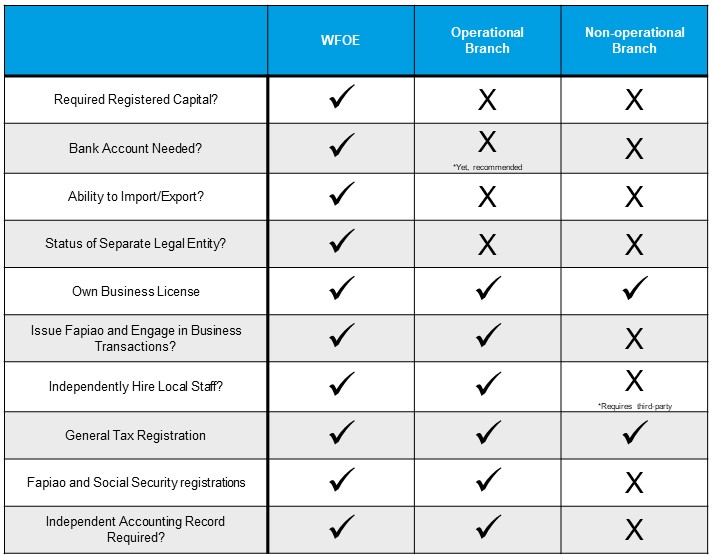
As evidenced by the comparison in the above table, we can observe several key differences between establishing a WFOE vs establishing a Branch Office in China. Firstly, whereas a WFOE must commit to an amount of Registered Capital (read our full article on Registered Capital here), a Branch Office does not have Registered Capital and thus presents a cost-effective expansion method. Furthermore, although recommended, it is optional for a Branch Office in China to open a bank account. Moreover, contrary to a WFOE, a Branch Office is not required to register a Legal Representative, Board of Directors, Supervisor, or General Manager. Instead, a Branch Office must only register a principal or responsible person (in Chinese: 负责人).
On the other hand, Branch Offices will experience several limitations compared to a WFOE. For example, Branch Offices cannot engage in certain activities, such as the import and export of goods, and they are limited in their business scope by the business scope of their head office.
It is crucial to note, however, that Branch Offices present a solution to a key compliance issue for WFOEs, namely the hiring of local staff (and subsequent contribution to the social securities, which in China are administered at the regional level) in a city other than the place of residence of the head office.
Procedures to Establish a Branch in China
As mentioned, setting up a branch office is less complex than establishing a WFOE, which first becomes evident as there is no requirement to provide legalized documents from the shareholder since the head office of a branch office is an existing Chinese legal entity.
As such, the company documents which are required for the establishment of a Branch Office are the following:
- Business license of existing Chinese subsidiary;
- Articles of association of existing Chinese subsidiary;
- Lease agreement;
- Identification document of the principal (负责人);
- Identification document of the financial contact person.
Upon collecting all the abovementioned documents, the application process can be started online through the Government’s Registration Service System for pre-approval. Upon receipt of the pre-approval, the company must prepare and sign all relevant application documents for a branch office set up and submit them via formal application to the local Administration for Market Regulation (AMR, formerly known as the AIC). The branch business license is issued after the AMR approves the submitted application documents. Based on our experience, it can take 1-2 months from pre-application until the obtention of the branch business license (incl. preparation and signing of relevant documents). Upon issuance of the business license, the Branch Office officially exists.
Subsequently, only a general tax registration with the tax bureau must be completed for non-operational branches. However, for a branch office to become fully operational, it will be required to complete the fapiao registration and the social security and housing fund registration. After this, operational branches may also elect to open a bank account. These additional procedures can take up to 1-2 months. In summary, setting up a non-operational branch will approximately take 1-2 months, whereas setting up an operational branch can take 2-4 months.
Branch Office Compliance Requirements
Regarding taxation, Branch Offices are subject to the same Corporate Income Tax (CIT) as their head office. If the Branch Office does not maintain a separate accounting record, the head office submits all tax declarations on a consolidated basis. If the branch office maintains an independent accounting record, it will file taxes with the local tax authorities accordingly.
It is essential to consider how the Corporate Income Tax filing for a Branch Office in China must be completed. When a Branch Office has been set up and issues invoices from the branch company to the client (i.e., an operational Branch), the Branch Office would have to pre-pay the first year every quarter Corporate Income Tax (when having tax assessable income) to the Tax Authority in the respective local district.
However, this can be difficult in practice since companies will be dealing with two different Tax Authorities in China, which are usually hesitant to lose tax revenue. Essentially, the result is a complication of the Annual CIT filing, where in case of more than two branch offices, the percentage of CIT paid by each Branch Office respectively shall be calculated according to the ratio determined by Tax Authorities based on revenues, salaries, and assets of the Branch Office.
Moreover, operational branches must conduct an annual audit if they maintain an accounting record independent of their head office. However, since branch office operations are generally less complex than a WFOE, the yearly audit proceedings are also expected to be more straightforward. Non-operational branches who do not maintain a separate accounting record are not required to perform an annual audit of their finances as these are included in the parent company’s accounting.
Furthermore, according to Article 72 of the labor law in China, employers and employees must pay social security contributions when hiring local staff directly. Consistent with the Law of the People’s Republic of China on Social Insurance and the Provisional Regulations on Housing Fund, the employer should complete the registration of employees with the company’s Social Security- and Housing Fund registration within 30 days of staff onboarding.
Setting Up a New Branch in China
In conclusion, Branch Offices are not separate legal entities and essentially are an expansion of their head office in China. The setup of a Branch Office offers several advantages compared to establishing an additional Chinese subsidiary, where the procedures and compliance requirements are less complex, making this expansion method more cost-effective. Additionally, and crucially, it is the only fully compliant solution to expand a company’s presence to another city in China outside its original residence if it intends to hire local Chinese staff.
We have successfully supported numerous foreign businesses in establishing a Chinese subsidiary or branch office throughout all regions of China and provided advice on this subject. If you want to enter the Chinese market or understand how establishing a branch office can support the expansion of your business in China, please visit our Corporate Services page or contact us.
FAQ

 General Guides
 Regional Guides
 Starter Guides