 General Guides
 Regional Guides
 Starter Guides



Send us your questions and we will answer within 24 hours Message →
Social Security Contributions in Shanghai
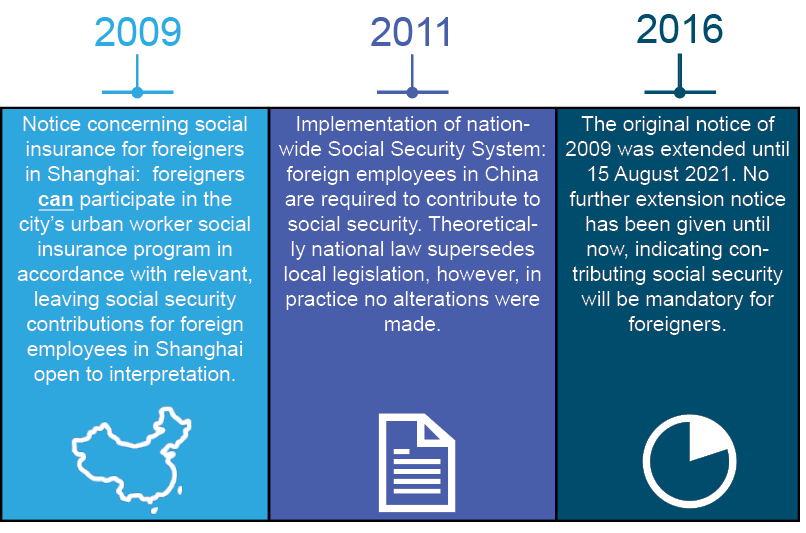
In 2009, the Shanghai Municipal Bureau of Resources and Social Security issued the notice stipulating foreigners can contribute to the social security system, leaving social security contributions for foreign employees in Shanghai open to interpretation. In practice, most foreign employees and their employers in Shanghai have chosen to opt out of the social insurance contributions.
The notice concerning the Participation of Urban Workers in Social Insurance for Foreigners Working in Shanghai, Persons Obtained Overseas Permanent (Long-term) Right of Residence, and Taiwan, Hong Kong and Macao Residents states that “foreign nationals who come to Shanghai with an Employment Permit can participate in the city’s urban workers social insurance program in accordance with relevant regulations. The basic endowment insurance, basic medical insurance and work-related injury insurance shall be stipulated in the labor (employment) contract.” This resulted in foreign employees and their employers to interpret that social security contribution is not a mandatory requirement in Shanghai and has since been tentatively accepted by the Shanghai Labor Bureau.
Later in 2011, following the implementation of the Social Insurance Law and after the “Interim Measures for Foreigners Working in China to Participate in China’s Social Insurance” were issued by the Ministry of Human Resources and Social Security, the Shanghai Municipal Bureau of Human Resources and Social Security did not modify the provision released in 2009. Additionally, we must note that according to the official website of Shanghai Municipal Bureau of Human Resources all domestic employers hiring foreign employees should pay social insurance – which is different than the 2009 notice. In the situation where the national law conflicts with a local law, the national law supersedes the local legislation. This would indicate that foreigners must contribute to the social security system in Shanghai in accordance with the Social Insurance Law and Interim Measure.
Nevertheless, in 2016 the original notice by the Shanghai Municipal Bureau of Resources and Social Security released in 2009 had been extended until 15 August 2021, meaning that in practice foreign employees and their employers in Shanghai continued to be exempt from paying social securities (see China-Briefing article). At this moment it is uncertain whether the notice will be extended again, however, upon expiration it would be mandatory for foreign employees and their employers to contribute to social security in accordance with national regulations.
Don’t risk back-payments and penalties — book a social insurance compliance check with MSA today. We’ll review your employee structure in Shanghai, verify past contributions and help you update your payroll setup correctly. Message →
In this section we highlight the method to calculate social securities and provide a scenario for social security contributions in which we compare the impact for both the employee and the employer considering current exemption for foreign employees with a situation in which social security contributions are made in line with national legislation.
An employee’s social security contributions are deducted directly from the gross salary while the employer’s contributions are added as an additional cost to the gross salary, which results in an increase in total employment cost of each employee.
It is important to note that:
- The contribution base is assessed on the employment income and the maximum employment income is capped at three times (300%) of the City Average Salary (CAS) of the prior year. Per July 2, the maximum cap is RMB 31,014 and minimum cap is 5,975.
- The employer is required to withhold the applicable social security contributions for the employee and have the funds available to cover both the monthly employer and employee costs. The payments are settled with the local security bureau monthly.
- The 2021 Shanghai Social Security Contribute rates are as below.
2021 Shanghai Social Security Contribution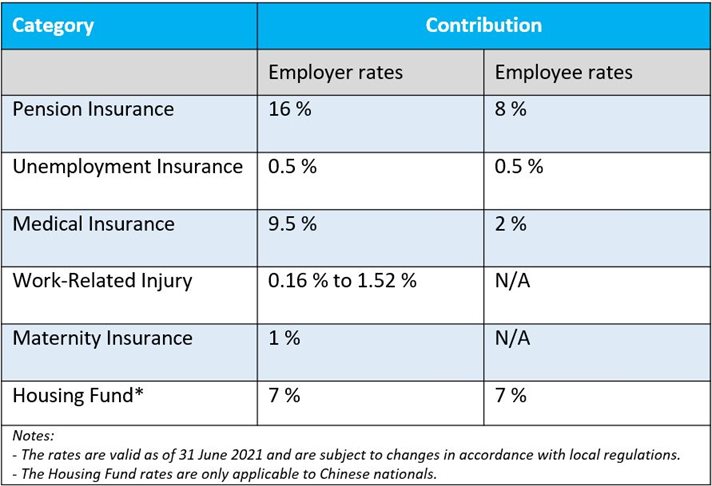
The following two scenarios will illustrate the total costs of employment for a foreign employee in Shanghai with a gross monthly salary of 20,000 RMB, considering scenarios with- and without social security contributions.
Total Costs without social Security – Foreign Employee in Shanghai (July 2021, RMB)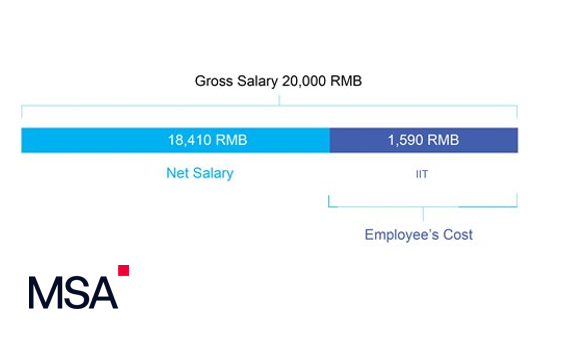
Note: The above example is the average over a full year. The exact monthly amounts will differ due to China’s accumulative IIT system, which causes the net salary of an individual to decrease throughout the year.
In the scenario in which foreign employees in Shanghai earning a gross salary of RMB 20,000 do not contribute to social securities in line with China’s national legislation, the total net salary received will be RMB 18,410 whereas total employer costs are equal to the gross salary.
Total Costs with Social Security – Foreign Employee in Shanghai (July 2021, RMB)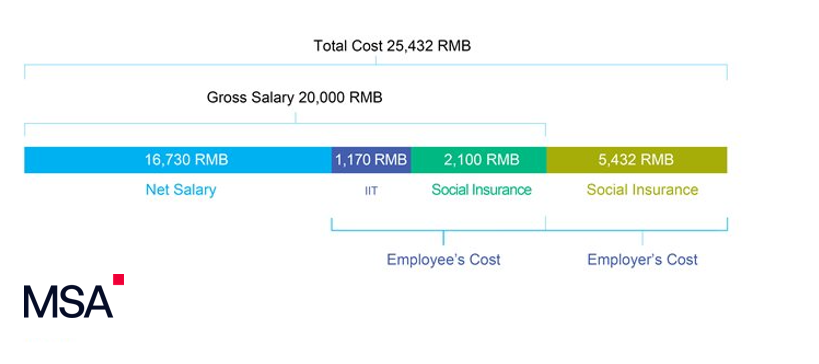
From the above example we can observe that when foreign employees must contribute to social securities, an employee with a gross salary of 20,000 RMB will received a reduced net salary of RMB 16,730, a reduction of 9.13%. On the other hand, total employer costs increase with RMB 5,432 or 27.16%.