 General Guides
 Regional Guides
 Starter Guides


At the end of 2024, China’s legislature formally enacted a comprehensive Value Added Tax (VAT) law that replaces the former patchwork of “interim” regulations. While the new law officially takes effect on January 1, 2026, it is already reshaping how businesses plan for compliance, invoicing, and cash-flow management.
For importers, exporters, service providers, and cross-border traders, the new legislation provides long-awaited certainty and clarity. It codifies practices that were previously scattered across multiple circulars, and it elevates VAT to the level of a national law passed by the National People’s Congress. This marks a milestone in China’s tax modernization, moving from administrative regulations to a unified statutory framework.
Below we outline the major updates and their practical impact on businesses operating in China.
Lower VAT rates
The new VAT law maintains the three-tier rate system of 13%, 9%, and 6%, and confirms that the top rate of 13% will remain permanent. This assurance brings stability for manufacturers and exporters that have faced uncertainty over temporary rate adjustments in the past.
For certain small-scale and specialized service sectors, the law provides for simplified taxation options, including possible preferential rates of 3%. These simplified methods aim to reduce administrative burdens on smaller taxpayers and improve compliance rates.
This means businesses should review their activities and determine whether any parts of their operations may qualify for simplified VAT treatment. System updates and internal training should be completed before the new law becomes effective in 2026.
Updated Definition of “Domestic Taxable Transactions”
A key change introduced under the new VAT law is the adoption of the “destination principle” for determining whether a transaction is taxable within China. This means that VAT is now based on where goods or services are consumed, not merely on the location of the seller or buyer.
Under the previous regime, transactions were considered domestic if either party was in China, regardless of where consumption occurred. Under the new framework, even if both the buyer and seller are located outside China, a transaction will still be deemed taxable if the goods or services are consumed within Chinese territory.
The law also broadens the definition of taxable goods and services to include financial instruments, such as bonds, derivatives, and foreign-exchange products. This aligns China’s VAT framework more closely with global standards and ensures a more consistent approach across sectors.
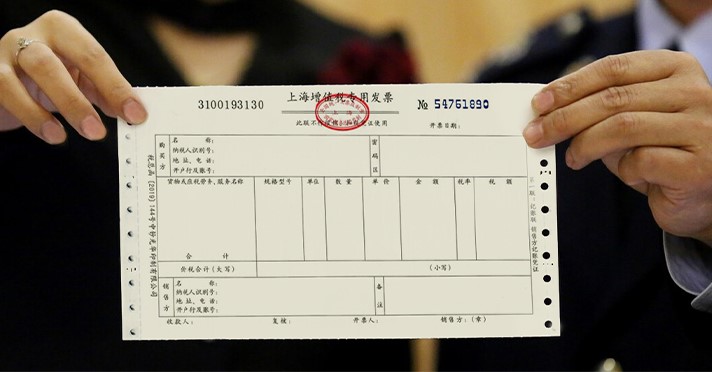
This means companies providing services or digital products to Chinese end-users should assess whether they are now liable for VAT registration, fapiao issuance, and domestic VAT reporting obligations.

Clarification of Nontaxable and Deductible Items
The new VAT law provides a clear and exhaustive list of non-taxable transactions, which are outside the VAT system entirely, as well as a refined structure for input VAT deductions.
Items that remain non-taxable include:
Wages for employment services;
Government and administrative fees;
Compensation for land or resource expropriation;
Interest income from bank deposits.
These have not changed from previous rules but are now clearly codified for legal certainty.
On the deduction side, the new law confirms that taxpayers may carry forward unused input VAT or apply for refunds when input VAT exceeds output VAT, improving cash-flow flexibility. It also clarifies which purchases qualify for deduction and explicitly excludes items such as employee benefits or personal consumption expenses.
This means that businesses in China need to conduct a thorough audit of deductible expenses, ensuring invoices (fapiaos) and supporting documentation comply with the updated law. Review any expenses that were previously treated as deductible to confirm their continued eligibility under the new framework.
China’s Value Added Tax Law imposes a 13% standard rate on goods, 9% on services and transportation, and 6% on selected services, with mechanisms for input tax credits and exemptions for certain activities. Proper VAT treatment depends on accurate activity classification and meticulous invoice management. VAT miscalculation exposes you to interest and penalties. MSA Asia structures your China tax filing VAT position. Reach out to us.

Stay compliant from day one. Talk to MSA’s China tax experts to understand how the new VAT law affects your company registration, fapiao issuance, and input-tax deductions, and book your consultation today. Message →