 General Guides
 Regional Guides
 Starter Guides

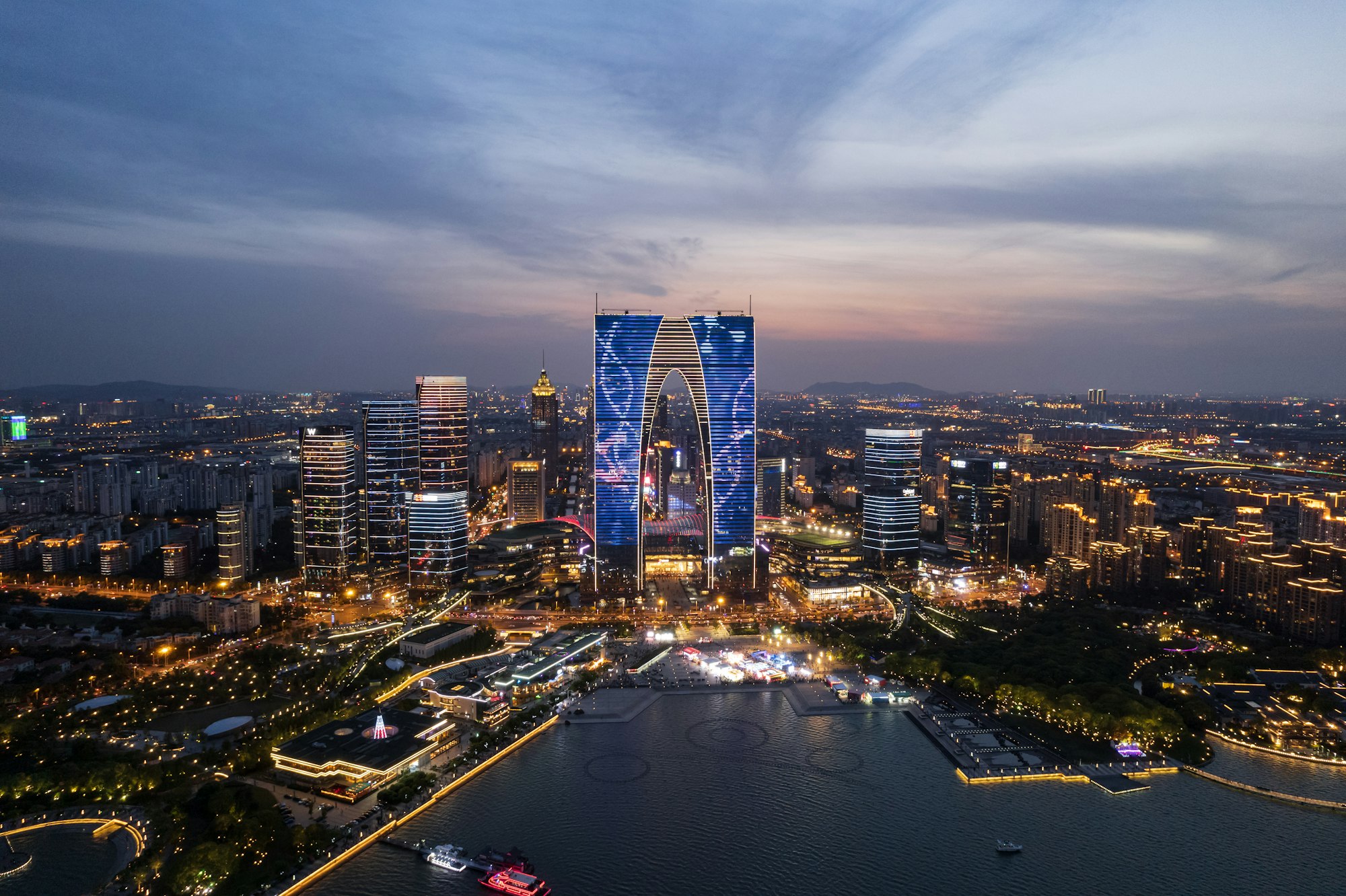
Suzhou Industrial Park (SIP), the flagship China-Singapore cooperation project established in 1994, has grown from an 8 km² start-up area into a 278 km² city in its own right and is now mainland China’s most successful single industrial park by accumulated FDI. The park has attracted more than 5,100 foreign-funded projects, including 174 projects from 104 Fortune 500 companies, with actual utilisation of foreign investment exceeding USD 40 billion.[1] Combined with the BioBay life sciences cluster (more than 330 biotech, medical-device, and IVD companies plus the Cold Spring Harbor Asia Conference Center), the SIP semiconductor cluster (Samsung, Hitachi, AMD, Renesas, plus Bosch’s October 2024 new-energy-vehicle R&D site), and Suzhou’s 25-minute high-speed rail link to Shanghai, the city has quietly become the working answer for foreign advanced-manufacturing, semiconductor, and biopharma groups that need Shanghai-quality access at a meaningfully lower cost.[2]
This guide is written for founders, CFOs, and general counsel who want to understand the trade-offs before they sign a lease. It covers the legal framework, district choices, the SIP and SND incentives, the Jiangsu FTZ Suzhou Area, registered capital under the 2024 Company Law, the current 2026 setup timeline, and the most expensive mistakes we see foreign investors repeat in Suzhou. If you are still mapping the broader entity decision, our full WFOE registration in China service page covers the national framework. This article zooms in on Suzhou.
Why Suzhou for a WFOE in 2026
Suzhou’s pull for foreign investors rests on four concrete factors that show up in the numbers, not in a brochure.
First, Suzhou Industrial Park is structurally different from any other Chinese industrial zone. The 1994 China-Singapore framework agreement built the park around foreign-investor needs from day one: bilingual administration, English-capable government services, a CEO-style park management with real authority through the Suzhou Industrial Park Administrative Committee (SIPAC), and a regulatory environment that takes Singapore-style “one-stop” service seriously. Foreign investors entering SIP routinely report the smoothest tier-1-equivalent SAMR experience in mainland China.
Second, the BioBay biopharma cluster inside SIP is now the largest concentration of life sciences companies in China outside Shanghai’s Zhangjiang. More than 330 companies operate across drug discovery, medical devices, IVD, biotech, and nanotech, anchored by the Cold Spring Harbor Asia Conference Center. The downstream ecosystem of CROs, CDMOs, and regulatory consultants is correspondingly deep — B. Braun added new SIP investment in April 2026, joining a long line of foreign medical-device groups that have used BioBay as their China innovation base.[2]
Third, the semiconductor and advanced-manufacturing footprint is the largest in the Yangtze River Delta outside Shanghai. Samsung, Hitachi, Bosch, AMD, and Renesas all run major Suzhou operations. Bosch launched a new R&D and manufacturing site for new energy vehicle core components and automated driving inside SIP in October 2024. The supplier ecosystem extends across SIP, SND, Kunshan, and Wujiang.
Fourth, Suzhou’s cost base is meaningfully below Shanghai while the talent pool is comparable in engineering and life sciences. Grade A office rent in SIP runs 30 to 40 percent below Shanghai’s Zhangjiang. Engineering salaries are 10 to 20 percent below Shanghai for equivalent seniority. The 25-minute high-speed rail link to Shanghai Hongqiao means executives and clients can move between cities in less time than a Beijing cross-town commute.
Suzhou Industrial Park: what 30 years of foreign-investor design produces
SIP covers 278 km² across the eastern half of Suzhou. The park is administered by SIPAC, which has CEO-style authority over land use, business approvals, talent attraction, and infrastructure. For foreign investors, the practical implications of the China-Singapore design are concrete:
- One-stop service centre. Business licence, tax registration, customs registration, and SAFE filings can be filed through a single SIPAC counter, with bilingual support.
- Talent housing and schools. SIP includes Dushu Lake Higher Education Town with branch campuses of Xi’an Jiaotong-Liverpool University, Renmin University, and others, plus international schools (Dulwich, EtonHouse) that ease expat family relocation.
- Sub-zone specialisation. Within SIP, BioBay focuses on life sciences, the Nanopolis cluster on nanotech, the AI-Town on artificial intelligence, and the Innovation Park on cross-border technology transfer. Sub-zone selection matters for talent attraction and supplier proximity.
- FTZ overlay. SIP sits inside the Jiangsu Pilot Free Trade Zone Suzhou Area (60.15 km²), giving qualifying entities access to bonded zones and simplified customs treatment.
BioBay and the Suzhou life sciences cluster
BioBay is located in Dushu Lake Higher Education Town inside SIP. It currently houses more than 330 high-tech innovation companies covering drug discovery, medical devices (including IVD), biotechnology, and nanotechnology, with the Cold Spring Harbor Asia Conference Center as the cluster’s research anchor. For a foreign biopharma or medical-device WFOE, the working advantages are: shared lab and animal-house facilities, NMPA registration support through the BioBay administrative office, proximity to CROs and CDMOs, and direct connection to the Yangtze River Delta clinical trial network.
Where to register: five Suzhou locations compared
These are the five locations foreign-invested companies actually shortlist when they pick a Suzhou address.
| Location | Best suited to | Key advantage | Watch-outs |
|---|---|---|---|
| Suzhou Industrial Park (SIP) | Biopharma, medical devices, semiconductors, AI, advanced manufacturing, regional headquarters | China-Singapore one-stop service via SIPAC; BioBay, Nanopolis, AI-Town sub-zones; Jiangsu FTZ Suzhou Area access; deepest expat infrastructure outside Shanghai | Highest Grade A rents in Suzhou; competition for talent intensifying |
| Suzhou New District (SND) | Electronics, precision machinery, optoelectronics, software | Established hi-tech zone since 1990; strong electronics supplier ecosystem; lower rents than SIP | Less foreign-facing administrative infrastructure than SIP |
| Kunshan Economic and Technological Development Zone | Electronics assembly, Taiwan-linked supply chain, IoT, smart manufacturing | Largest concentration of Taiwan-invested enterprises in mainland China; strong cross-strait supplier ecosystem | Kunshan is a separate county-level city; administrative procedures are not identical to Suzhou proper |
| Wujiang Economic and Technological Development Zone | Textiles, fibre, light industry, lakeside tourism, e-commerce | Established light-industry cluster; lower industrial land costs; integrated with Shanghai Qingpu via the Yangtze River Delta Ecological and Green Demonstration Zone | Less suitable for high-tech or biopharma WFOEs |
| Gusu (Old Town) | Service WFOEs, cultural and creative, tourism, professional services | UNESCO-protected historic centre; concentration of foreign service firms; walking distance to consulates and government | Very limited industrial or large-scale tech infrastructure |
Biopharma and semiconductor groups almost always end up in SIP. Electronics groups split between SND and Kunshan depending on Taiwan-linked supplier needs. Light industry and textiles belong in Wujiang. Service WFOEs gravitate to Gusu. Pick the location to match the operating model and supplier ecosystem.
Registered capital: what Suzhou SAMR will actually accept
There is no statutory minimum registered capital for most WFOE business scopes in Suzhou.[3] Suzhou SAMR (and SIPAC for SIP-registered entities) reviews capital declarations for reasonableness against the proposed business scope. Set capital too low and the licence application stalls. Set it too high and Article 47 of the 2024 Company Law forces you to fund a vanity number you never needed.[4]
| Business type | Typical registered capital accepted | Why Suzhou SAMR looks at it |
|---|---|---|
| Consulting / services WFOE | RMB 100,000 to 500,000 | Must cover roughly 12 months of office, salaries, social insurance |
| Trading WFOE (FICE) | RMB 500,000 to 1,500,000 | Must demonstrate capacity to pre-fund inventory or working capital |
| Electronics or precision manufacturing WFOE | RMB 2,000,000 to 10,000,000+ | Must cover lease, equipment, EIA, and initial production runs |
| BioBay / biopharma WFOE | RMB 3,000,000 to 20,000,000+ | Must cover lab equipment, GMP fit-out, and clinical or pre-clinical runway |
| Semiconductor / advanced manufacturing WFOE | RMB 10,000,000 to 100,000,000+ | Must cover fab equipment, EIA, and multi-year production-ramp runway |
The 2024 Company Law five-year rule
Article 47 of the revised PRC Company Law took effect on 1 July 2024. It requires the subscribed registered capital to be paid in within five years of incorporation. For companies established before 1 July 2024, the transition period for compliance ends on 30 June 2027. Set the capital to your realistic 36-month plan. You can always increase it later through the SAMR change procedure. For more, see our companion guide on minimum registered capital for a WFOE in China.
Setup timeline and costs for a WFOE in Suzhou
Suzhou is among the fastest tier-1-equivalent jurisdictions for the licence-issuance steps, particularly for SIP-registered entities that benefit from the SIPAC one-stop service. A clean consulting or trading WFOE in Suzhou is typically operational within four to six weeks.
| Activity | Typical timeline | Notes |
|---|---|---|
| Name pre-approval | 1 to 3 days | Online via Suzhou SAMR or SIPAC; bilingual name format |
| Business licence | 1 to 2 weeks | 5 working days for clean cases; SIPAC one-stop service is the fastest track |
| Tax, customs, SAFE, social insurance | 2 to 4 weeks | Can be parallelised; SIP and SND tax bureaus are most experienced with foreign filings |
| Bank account (Chinese bank) | 2 to 3 weeks | Bank of China, ICBC, China Construction Bank, ABC, Bank of Suzhou branches |
| Bank account (foreign bank) | 4 to 6 weeks | HSBC, Standard Chartered, DBS, Citi, OCBC, UOB — strong Singapore-link presence in SIP |
| Capital injection and SAFE update | 1 week | After bank account is open and capital account is approved |
A standard consulting or trading WFOE in Suzhou is operational within 4 to 6 weeks from name pre-approval to a usable bank account. Manufacturing WFOEs in SIP, SND, or Kunshan add the Environmental Impact Assessment, equipment commissioning, and any sector-specific licensing, stretching the total to 3 to 4 months. Biopharma WFOEs in BioBay add NMPA pre-clinical and clinical trial filings on top.
If you are running a remote setup, our guide on how to open a business in China remotely explains the document-flow and notarisation steps that drive the early-week timeline.
Bank accounts in Suzhou: Chinese versus foreign banks
Every WFOE needs at least two accounts: a basic RMB account for operating cashflow and tax payments, and a foreign currency capital contribution account approved by SAFE for receiving the registered capital injection from the foreign parent.
Bank of China, ICBC, China Construction Bank, ABC, and Bank of Suzhou run substantial branches in SIP and the rest of the city. Foreign banks have an unusually strong Suzhou presence for a non-tier-1 city, partly thanks to the China-Singapore framework: HSBC, Standard Chartered, DBS, OCBC, and UOB all operate dedicated SIP branches with extensive SIP-tailored cash management and trade finance products. The 25-minute high-speed rail to Shanghai Hongqiao means many CFOs run their primary banking through a single relationship that covers both cities.
Capital injection mechanics are the same across all banks. The foreign parent wires the registered capital to the capital contribution account in foreign currency. The bank then completes the SAFE registration update before the funds can be settled into RMB and used. Plan for a one-week buffer between funds arrival and operational availability.
The five most expensive Suzhou WFOE mistakes
These are the recurring patterns we see foreign investors repeat in Suzhou. None of them is theoretical.
Mistake 1: Picking a non-SIP location to save on rent when SIP is the right fit
SIP costs more than SND, Kunshan, or Wujiang on rent and labour, but the SIPAC one-stop service, the BioBay or Nanopolis sub-zone access, and the foreign-investor-friendly administration usually pay back the cost premium within the first 12 months. WFOEs that pick SND or Wujiang to save 15 percent on rent and then end up duplicating registration efforts to access SIP suppliers and regulators usually wish they had registered in SIP from the start.
Mistake 2: Treating Kunshan as identical to Suzhou for administrative purposes
Kunshan is a county-level city under Suzhou’s administrative jurisdiction but its SAMR, tax bureau, and customs office operate independently. Procedures, timelines, and even some sub-rules differ from SIP and SND. WFOEs setting up in Kunshan should plan for Kunshan-specific filings rather than assuming Suzhou-wide rules apply.
Mistake 3: Underestimating BioBay and Nanopolis sub-zone admission
Sub-zones inside SIP have their own admission criteria. BioBay vets entrants on biotech relevance, IP portfolio, and team substance. A general-services WFOE will not be admitted to BioBay even with a SIP address. Plan the sub-zone application as a separate workstream.
Mistake 4: Setting vanity registered capital that Article 47 will force you to fund
The 2024 Company Law five-year paid-in rule has changed the calculus. RMB 50 million capital that looked good on a business card in 2023 is now a binding obligation to wire RMB 50 million by year five. Set capital to your real 36-month plan. Manufacturing and biopharma WFOEs should size capital to the realistic equipment and runway plan, not to a marketing number.
Mistake 5: Missing the EIA timeline for Wujiang or SND manufacturing
Wujiang and SND host mature manufacturing clusters with active environmental enforcement. Environmental Impact Assessment timelines can stretch from three to six months for complex industrial WFOEs. Build the EIA into the launch timeline rather than treating it as an afterthought.
If you are still weighing entity types, our comparison guide on WFOE vs JV vs representative office maps when each structure makes sense.
Suzhou versus Shanghai versus Hangzhou: which fits your business
A short orientation, since this is the comparison we are asked about most often in Suzhou-bound calls.
Choose Suzhou if your business is biopharma, medical devices, semiconductors, electronics, or advanced manufacturing, particularly if you fit the BioBay, Nanopolis, AI-Town, or SIP sub-zone profiles. Suzhou’s cost arbitrage versus Shanghai is real and the talent pool is comparable in engineering and life sciences.
Choose Shanghai if your business benefits from Lingang’s 15% CIT incentive in the four FTZ priority sectors, if you need FT account access for cross-border RMB cash pooling, or if you need the deepest foreign-facing service infrastructure in mainland China. Compare with our Shanghai WFOE guide.
Choose Hangzhou if your business is e-commerce, AI, robotics, SaaS, or anything that benefits from the Six Little Dragons and Alibaba ecosystems. Compare with our Hangzhou WFOE guide.
Suzhou is the right answer for foreign manufacturing and life sciences groups that want Shanghai-quality access without paying Shanghai prices.
Frequently asked questions
How long does it take to set up a WFOE in Suzhou?
What is the minimum registered capital for a WFOE in Suzhou?
What is Suzhou Industrial Park (SIP) and why does it matter for foreign WFOEs?
Do I need a Chinese partner to open a WFOE in Suzhou?
Which Suzhou location is best for a biopharma WFOE?
Can I use a virtual office to register a WFOE in Suzhou?
What does the 2024 Company Law five-year rule mean for a Suzhou WFOE?
Can a Suzhou WFOE repatriate profits to its foreign parent?
Closing thoughts
Suzhou is the answer for foreign biopharma, semiconductor, and advanced-manufacturing groups that want Shanghai-quality access without paying Shanghai prices. The 30-year-old China-Singapore framework around Suzhou Industrial Park has produced the most foreign-investor-friendly administrative environment in mainland China — 5,100+ foreign-funded projects, 174 Fortune 500 footprints, and USD 40B+ in actual FDI utilisation — and the BioBay, Nanopolis, AI-Town, and SIP semiconductor sub-zones together host an ecosystem that no other tier-2 city can replicate.
For founders and CFOs, the steps that actually matter are: pick the location that matches the operations and the sub-zone that matches the sector, set the registered capital to a real 36-month plan, and treat licences as additive timelines on top of the WFOE setup. The most common Suzhou-specific failure modes — picking SND or Wujiang to save 15 percent on rent when SIP fits, treating Kunshan as identical to Suzhou administratively, missing sub-zone admission requirements, and underestimating EIA timelines — are all avoidable with a clean spec at the start.
If you are weighing Suzhou as your China entry city or as the location for a biopharma, semiconductor, or advanced-manufacturing entity, our team can run the location-and-capital decision in a single working session and hand you a scoped budget. Start with the WFOE registration in China overview or our broader China company registration service, or contact us directly for a Suzhou-specific scoping call.
- China Daily, “Suzhou Industrial Park a window to innovation, opening-up” (Dec 2024) — 5,100+ foreign-funded projects, 174 Fortune 500 projects, USD 40B+ actual FDI utilisation across 278 km².
- Suzhou Industrial Park Administrative Committee (SIPAC) official portal — China-Singapore framework, BioBay/Nanopolis/AI-Town sub-zones, one-stop service, Bosch Oct 2024 NEV/AD R&D investment, B. Braun April 2026 SIP investment add.
- China Briefing, “China Registered Capital: A Comprehensive Guide for Foreign Businesses”.
- PRC Company Law as revised by the Standing Committee of the National People’s Congress, 29 December 2023; Article 47 effective 1 July 2024.