 General Guides
 Regional Guides
 Starter Guides

General Overview of SAFE
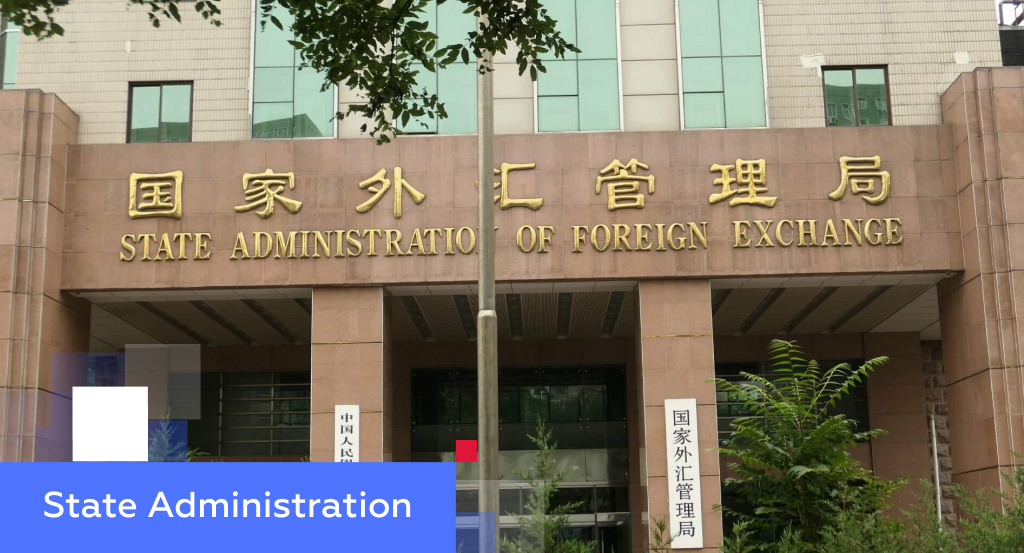
Shortly after the Chinese economy opened in 1978, the State Administration of Foreign Exchange was established (formally in March 1979).
SAFE is represented in all provinces, autonomous regions, municipalities, and cities with sub-provincial status directly under the central government’s control. Moreover, the administration operates sub-branches in prefectural-level and county-level cities. As a result, the SAFE network in Mainland China consists of 36 administrative offices with 309 central sub-branches and 517 sub-branches. Additionally, SAFE has official representations in Hong Kong, Singapore, London, and New York.
As mentioned above, the State Administration of Foreign Exchange (SAFE) is part of the People’s Bank of China and is responsible for governing foreign exchange market activities in China and managing the foreign exchange of the RMB. The administration’s goal is to establish a macro-prudential and micro-regulatory management framework for cross-border capital flows.
Macro-prudential measures are taken by SAFE to reverse the cyclical fluctuation of the foreign exchange market, prevent cross-market, cross-institutional, cross-currency, and cross-border contagion of international economic and financial risks, and most importantly, maintain the market’s stability. This commitment to stability should reassure businesses operating in China, as it provides a secure and predictable environment for their operations.
Responsibilities of the State Administration of Foreign Exchange
In line with the goal of the State Administration of Foreign Exchange to establish a macro-prudential and micro-regulatory framework, several administration responsibilities can be identified. Firstly, the SAFE has the following responsibilities related to the drafting of policies and regulations:
- Propose policy suggestions on the reform of the foreign exchange administration system.
- Implement policy measures for the advancement of the convertibility of the RMB and the cultivation and development of the foreign exchange market.
- Provide suggestions to the People’s Bank of China to formulate policy on the RMB exchange rate.
- Draft laws, regulations, and departmental rules on foreign exchange administration.
On the other hand, SAFE is responsible for the supervision and implementation of rules and regulations in relation to foreign exchange, including:
- Monitoring cross-border capital flows, balance of payments, and external credit and debt.
- Supervising and managing the settlement and sale of foreign exchange.
- Ensuring the authenticity and legality of the receipt and payment of foreign exchange under the current account.
- Implementing foreign exchange administration under the capital account.
Furthermore, SAFE is also responsible for managing the state’s foreign exchange reserves, gold reserves, and other foreign exchange assets and for maintaining the balance of payments equilibrium.
Summary of SAFE Responsibilities
| Category | Responsibilities |
|---|---|
| Policy and Regulation Drafting | – Propose policy suggestions on the reform of the foreign exchange administration system. – Implement policy measures for the advancement of the convertibility of the RMB and the cultivation and development of the foreign exchange market. – Provide suggestions to the People’s Bank of China to formulate policy on the RMB exchange rate. – Draft laws, regulations, and departmental rules on foreign exchange administration. |
| Supervision and Implementation | – Monitoring cross-border capital flows, balance of payments, and external credit and debt. – Supervising and managing the settlement and sale of foreign exchange. – Ensuring the authenticity and legality of the receipt and payment of foreign exchange under the current account. – Implementing foreign exchange administration under the capital account. |
| Asset Management | – Managing the state’s foreign exchange reserves, gold reserves, and other foreign exchange assets. – Managing the balance of payments equilibrium. |
Impact of SAFE on Businesses in China
Although some of the responsibilities of the State Administration of Foreign Exchange relate to policy formulation, it is expected that all foreign-invested enterprises in China will have to deal directly or indirectly with SAFE in some instances. Generally, SAFE will be involved whenever funds are transferred to or from a foreign country. It is necessary to obtain foreign exchange approval from SAFE for, among other things:
- All capital account transactions (e.g., related to the registered capital account).
- Current account transactions (local banks implement the approval process set out by SAFE).
- All company loans (inward and outward) are under the scrutiny of SAFE.
These occasions include bringing in the registered capital, service fee payments, profit repatriation, trade payments, and loan and interest-related payments. Over the past years, SAFE has delegated most of its approval responsibilities to banks. Banks will screen the necessary documents on behalf of SAFE and execute the transactions if they meet the requirements. However, approval for trade payments, accounts payable extensions, and loan extensions still must be filed directly with SAFE.
Let MSA review your capital-flow processes and ensure your structure is compliant. Contact us for a free initial assessment. Message →
SAFE approval timelines for forex and repatriation can extend outbound payments by weeks or months—delays that disrupt payment schedules unless anticipated in cash flow planning carefully. Advance filing and relationship-building with SAFE offices accelerates approvals substantially. corporate finance planning includes SAFE approval coordination and timeline management. MSA Asia expedites your forex approvals. Reach out to optimize SAFE application strategies.