 General Guides
 Regional Guides
 Starter Guides


Employers have a range of HR compliance obligations in China. One important question that we frequently get asked is what documentation an employer needs to file.
This article outlines the key documents regarding onboarding or offboarding employees in China.

Send us your questions and we will answer within 24 hours Message →
1. Labor Contract
The labor contract is the most important document when creating a new employment relationship, as required by the Labor Contract Law of the People’s Republic of China (LCL). Chinese labor contracts must be in Chinese and signed by the employee within 30 days of the starting date. Otherwise, the company might need to compensate the employee for failing to formalise tje employment relationship (employer liability may include paying double wages) (see: Benesch Law PDF- ALERT: China’s New Labor Contract Law).
Furthermore, an employment contract should contain clauses that are still valid after the contract period to protect the company’s interests (for more details, see our extensive guide, Labor Laws and Labor Contracts in China).
Offer letters are not official employment documents. While offer letters document negotiations, the formal employment relationship is established via the labor contract under Chinese law. Nevertheless, we recommend keeping them since they clearly document the negotiation process.
Reach out to MSA now for an HR compliance audit and get peace of mind before you hire your next employee in China. Message →
2. Employee Handbook
The employee handbook is a very important employment document in China. It specifies all company policies not part of the labor contract and is an essential instrument for clarification in addition to the labor contract. In light of this, the labor contract should include a clause stating that the employee handbook is equally important to the labor contract.
In legal disputes at the labor arbitration court, the employee handbook is essential in proving whether an employee has acted in contravention of company policies.
3. Policies to Protect Special Rights
If a company provides specialized services or owns intellectual property that needs to be protected, it might consider implementing special policies in addition to the employee handbook. Like the employee handbook, the labor contract should refer to these special policies and state that they are considered equally important to the labor contract.
4. Diplomas and Certificates
Depending on the company’s internal requirements and industry and labor protection laws, an employer should ask for their employees’ diplomas and certificates. These documents provide the new employer with certain proof of education or training required as a qualification for employment. By signing the labor contract, the employee ensures all documents and information provided are authentic and correct.
5. Social Security De-Registration Confirmation
Confirmation of de-registration of social security is essential for an employer to hire new staff. It ensures that a company’s new employee is no longer registered for Social Security, Housing Fund, or Individual Income Tax with another company.
An official confirmation notice can be obtained when de-registering an employee from the Social Security and Housing Fund; however, it is uncommon for employees to receive confirmation from their previous employer.
Once a new labor relationship is established, the new employer must register the employee for Social Security and Housing Fund contributions with the latest company in the tax system. The registration in the system should be smooth if the old employer has correctly completed all de-registration procedures. Otherwise, it might be necessary to coordinate this process with the former employer respectively.
Key Onboarding & Off-boarding Documents for Employer Compliance in China
| Document | Purpose | Employer action required | Compliance risk if omitted |
|---|---|---|---|
| Labor Contract | Formalises the employment relationship | Sign a written contract in Chinese within 30 days of start date; reference applicable company policies | Potential double-wage liability; contract deemed open-ended; weaker position in disputes |
| Employee Handbook | Sets out rules and company policies not in the labor contract | Publish, communicate, and obtain acknowledgment; cross-reference in the labor contract | Weak basis for discipline/termination; higher risk at arbitration |
| Social Security De-registration Confirmation | Confirms the employee is no longer registered with the prior employer | Request de-registration proof; register the new hire for Social Security & Housing Fund promptly | Duplicate or failed registrations; contribution errors and potential penalties |
| Resignation Confirmation from Previous Employer | Verifies end of prior employment and flags non-compete risks | Obtain chopped confirmation letter; review non-compete and conflict clauses | Hidden obligations or disputes with previous employer; onboarding delays |
| Diplomas & Certificates | Evidence of required qualifications or industry certifications | Collect copies; verify authenticity and validity for regulated roles | Unqualified hires; regulatory non-compliance; reputational risk |
6. Resignation Confirmation from Previous Employer
An officially chopped resignation confirmation letter confirming that the employee is no longer employed with their previous employer provides further proof to the future employer that there are no risks that may arise from the previous employment. A company should ask whether a confirmation letter was issued to the employee before the latter signs the new employment contract.
At the same time, the new employer must check whether the employee might violate any non-competition clauses with his previous employer to avoid any negative impacts on the company.
A letter of confirmation ensures that the previous employer officially confirms these items and that there is no risk that the employee might not be able to start the position due to a violation of a previous labor contract.
7. Labor Brochure
An important document for Chinese individuals in some cities, like Shanghai, is the individual labor brochure (劳动手册). The labor brochure contains personal information, including employment history or the employee’s education. Requirements for which information must be included vary across regions.
In Beijing and Shanghai, employers must keep their staff’s labor brochures throughout the entire employment period. Foreign companies with Representative Offices in China are not allowed to hire Chinese nationals as employees directly; however, they can engage an HR dispatching service provider to employ and keep the labor brochure of the employee hired on behalf of the Rep Office.
8. General Health Check
In some industries, especially those related to food and beverages, catering, or the service industry, employees must provide their history of infection and cure of infectious diseases. The new employer can also request a general health check, for which the employee needs to give the examination report.
9. Data Collection & Data Protection:
With the implementation of the Personal Information Protection Law (PIPL) by the Chinese government in 2021, companies need to pay more attention to collecting the personal data of their employees. Collection shall be justified, legal, and necessary by being limited in fulfilling the purpose of the collection.
Employees must also be informed about the data collection method, and an employer must obtain the employee’s consent to collect the data. When collecting more sensitive data, employers must prove a special purpose and obtain separate confirmation from the employee.
Minimum required data
Below is our recommended best practice for the minimum data an employer should save to compliantly register the employee with the company and make salary payments.
On boarding information: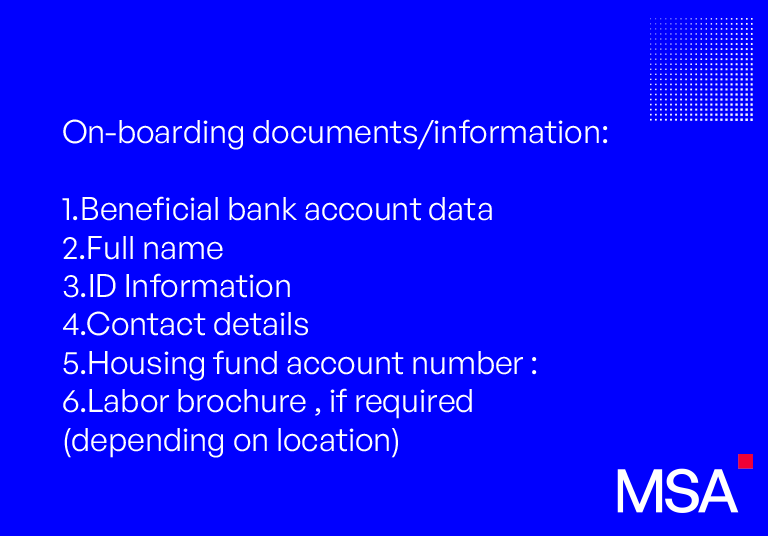
Documents for the employment: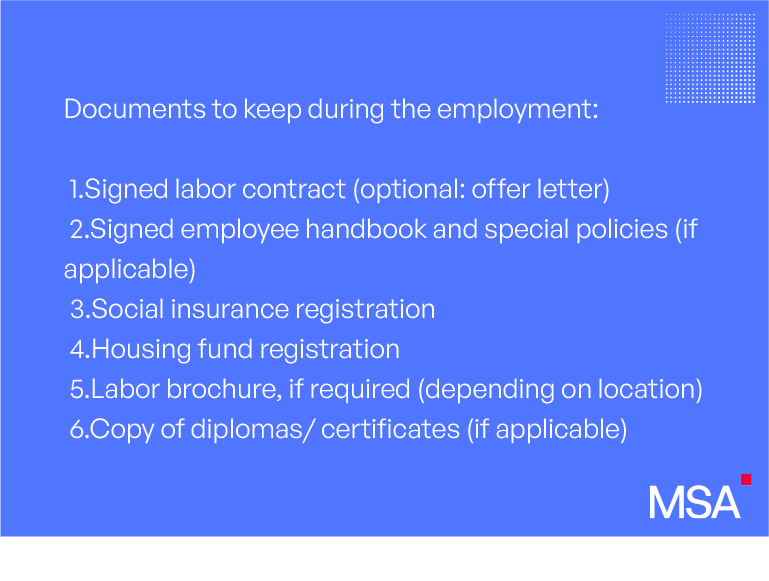
Employees in China are entitled to specific documents including written contracts, handbooks, and pay stubs, with missing documentation creating compliance risk and potential disputes. MSA Asia’s HR & payroll team ensures your documentation framework is complete and compliant. Reach out today for documentation review.