Trusted by Siemens, LVMH, Bosch & 1,500+ Companies
15 Years in Asia
56 Local Experts
★★★★★ G2 Top-Rated
Back
China Foreign Permanent Resident ID Card
Harm Hoonstra
Obtaining a Foreign Permanent Resident ID Card in China has become a significant milestone for many expatriates. This card is a legal identification document that facilitates various aspects of life, including financial transactions, education, healthcare, and employment. The new version of the Foreign Permanent Resident ID Card, issued on December 1, 2023, brings enhanced features and improved security measures, ensuring a smoother experience for cardholders.
The card is essential for foreigners residing in China, allowing them to exit and enter the country with their passports and residence certificates. The updated card design, unveiled in September 2023, addresses earlier challenges and aims to provide greater convenience and accessibility.
The National Immigration Administration supervises the issuance of the card, and qualified applicants now benefit from streamlined application procedures. This new step marks a progressive move toward better integration and support for the expatriate community living in China.
Send us your questions and we will answer within 24 hours
Message →
Background of the Chinese Foreign Permanent Resident ID Card
The Chinese Foreign Permanent Resident ID Card allows eligible foreigners to live and work in China. This section explores the legislative groundwork and the criteria determining card eligibility.
Legislative Origin
The legislative basis for the foreign permanent resident ID Card in China was established in 2004. The Ministry of Public Security and the Ministry of Foreign Affairs issued Order No. 74, implementing the “Administrative Measures for the Approval of Foreigners’ Permanent Residence in China.” The State Council approved this framework on December 13, 2003.
These measures outline the regulatory guidelines and procedures for approving foreign permanent residency. The goal was to manage the growing number of foreign residents and streamline their integration into Chinese society. The issuance and renewal processes have evolved, most recently with significant updates announced by the National Immigration Administration in 2023.
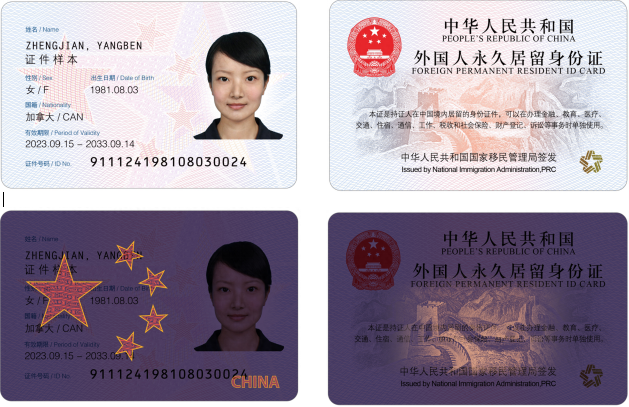
Close-up of the newly issued China Foreign Permanent Resident ID Card, showcasing its updated design and features.
Eligibility Criteria
Applicants must meet specific eligibility requirements to apply for the Chinese Foreign Permanent Resident ID Card. These criteria generally include a lengthy residency in China, contributions to Chinese society, or family ties with Chinese citizens or permanent residents. Key factors also include employment history, educational background, and financial stability.
Qualified applicants may typically encompass high-level executives, technical experts, and individuals investing significant capital in the country. Exceptional cases and additional categories are also considered, aiming to attract and retain skilled professionals and investors. The latest updates and procedural details are on the official government website.
Application Procedure for the ID Card
Obtaining a Foreign Permanent Resident ID Card in China involves preparing specific documents, following a detailed application process, and understanding the processing timeframes.
Required Documents
Applicants for the Foreign Permanent Resident ID Card must gather several essential documents.
Documentation includes a valid passport and visa. Additionally, applicants need proof of legal status, such as a resident permit. Depending on the applicant’s specific situation, legal employment or study documents are often required.
A completed application form must also be submitted. It’s crucial to provide recent passport-sized photos. Applicants need a health examination report done at an approved hospital. Relationship proof, such as marriage or birth certificates, is mandatory for family members.
Application Process
The application process starts with submitting all required documents to the local Public Security Bureau (PSB) Entry and Exit Administration.
First, fill out the application form accurately and submit it along with identification documents and accompanying materials. Then, you must undergo a personal interview, during which officials verify the applicant’s information.
After the interview, the application undergoes a review. During this stage, applicants might be required to submit additional documents. Once approved, applicants receive notification for ID card issuance. As part of this process, applicants pay a processing fee of CNY ¥300.
Processing Timeframes
The processing of the Foreign Permanent Resident ID Card generally takes several months.
After submission and initial review, the official decision should take about six months. This period may vary based on the completeness and accuracy of the provided documents.
Following approval, the issuance of the ID card might take additional time. Maintaining contact with the authorities is essential to check on the status. Managing personal documents and following all instructions can help in timely processing, though occasional delays can still occur.
Direct communication with the local PSB can offer better insights into realistic expectations for processing times.
Benefits of Holding the ID Card
The Foreign Permanent Resident ID Card in China offers several significant advantages. These include residency rights, improved employment and business opportunities, and access to public services.
Residency Rights
Individuals with the Foreign Permanent Resident ID Card gain the right to reside in China indefinitely. This card eliminates the need for visa renewals, streamlining the process for long-term stays. Cardholders also enjoy fewer restrictions on travel within China, making it easier to explore different regions and cities. Furthermore, having this card facilitates the re-entry process for those who frequently travel abroad, ensuring seamless movement across borders.
Employment and Business Opportunities
The card grants its holders the ability to work legally in China without needing additional work permits, opening up a broader range of job opportunities in various sectors. Entrepreneurs can establish businesses more efficiently, benefiting from reduced bureaucratic hurdles. Foreign employees and business owners can also engage in private and government projects, enhancing career prospects and business growth.
Access to Public Services
Holding the Foreign Permanent Resident ID Card allows access to various public services in China. Cardholders can benefit from access to healthcare services similar to Chinese citizens, including public hospitals and health insurance options. Moreover, their children can attend public schools and participate in public housing schemes. This inclusion in public services contributes to a more stable and integrated life in China.
Navigating China’s permanent residency regulations can be complex. MSA provides expert guidance to help you meet eligibility requirements, prepare documentation, and avoid delays. Speak with our advisors for tailored support.
Message →
Legal Implications
The new Foreign Permanent Resident ID Card in China has several important legal aspects. It outlines cardholders’ rights and obligations and how the card impacts their nationality status.
On December 1, 2023, Berezkin Rostislav from Russia proudly displayed the newly issued Foreign Permanent Resident ID Card, framed as a keepsake, at the exit-entry administration bureau of the Shanghai Public Security Bureau in Shanghai, eastern China. [Photo/Xinhua]
Rights and Obligations
Foreigners holding the new Permanent Resident ID Card in China are granted several rights similar to those of Chinese citizens. These include access to social services, education, and working without additional permits.
Cardholders also enjoy the convenience of simplified administrative processes. For instance, they don’t need extra permits for residence or employment. Additionally, they can open bank accounts, register vehicles, and get driving licenses more easily.
On the other hand, these cardholders must comply with Chinese laws and regulations. They need to report any changes in personal status, such as address or employment. Failing to meet these obligations can result in penalties or revocation of their resident status.
Impact on Nationality
Holding a Foreign Permanent Resident ID Card does not equate to obtaining Chinese nationality. It allows foreigners to live and work in China but does not grant voting rights or other nationality-related privileges.
The card does not affect the cardholder’s original nationality. Foreigners retain citizenship while enjoying many rights in China, creating a dual-benefit situation without a legal nationality shift.
However, acquiring this card can influence one’s application for naturalization should they seek Chinese citizenship later. The permanent residency status may streamline their eligibility and process, aligning with China’s immigration policies.
Card Features and Security
The new version of the Foreign Permanent Resident ID Card in China incorporates advanced security features to enhance its uniqueness and safety. These improvements help manage the card and protect personal information more effectively.
Physical Attributes
The new ID card has updated physical attributes designed for improved usability.
The card number has been expanded from 15 digits to 18 digits, which increases its uniqueness and security.
The card material has been upgraded to improve durability.
It includes a new layout with clearly visible information such as name, gender, and nationality.
The card size remains user-friendly, making it easy to carry and handle.
Progress in physical design aims to make the card more practical and longer-lasting.
Anti-counterfeiting Measures
Enhanced anti-counterfeiting technologies make the new ID card more secure.
It incorporates advanced anti-counterfeiting technologies like holograms and watermarks.
Features include micro text and UV patterns that are difficult to replicate.
A secure chip is embedded to store sensitive information, which can only be accessed via authorized devices.
These features ensure that the card remains authentic and safeguards personal information effectively.
Key Differences Between the Old and New Foreign Permanent Resident ID Cards
Feature Category
Old Version
New Version (2023 Update)
Card Number Format
15 digits
Updated to 18 digits for increased uniqueness and security
Material Quality
Standard plastic
Upgraded composite for enhanced durability
Security Features
Basic anti-counterfeiting
Holograms, micro-text, UV elements, and encrypted chip
Usability
Limited integration
Improved compatibility with banking, transport, and public services
International Recognition
Moderate
Increasing recognition for identity verification abroad
Renewal and Replacement
Foreigners holding a China Foreign Permanent Resident ID Card must renew their cards before expiration or replace them if lost or damaged. Timely application for renewal or replacement ensures legal compliance and continuous use.
Renewal Process
Holders must apply for renewal within one month before their ID card expires. This is crucial to avoid any disruptions in legal status. The renewal application requires submitting the existing ID card, a completed application form, and other necessary documents to the local Public Security Bureau.
If the card’s details change, such as name or address, holders should apply for renewal within one month of the change.
New ID cards are typically issued within several weeks of application, provided all documents are in order, and there are no complications.
Replacement of Lost or Damaged Cards
If a card is lost or damaged, holders must promptly apply for a replacement to maintain their legal resident status. A report detailing the loss or damage should be filed at the local Public Security Bureau.
Applicants must submit a replacement application, provide a valid identification document, and possibly include a notarized loss statement.
Replacement cards follow a similar issuance timeline as the renewal process, ensuring minimal inconvenience.
Key Features of Recognition
Feature
Details
Banking
Use the card to open bank accounts in China.
Property Purchase
Allows foreigners to buy property more efficiently.
Social Services
Access healthcare and other social benefits.
Travel
Simplifies entry and exit procedures at borders.
Internationally, the card is increasingly being recognized by foreign governments and institutions. This acceptance helps cardholders travel and conduct business with less hassle. For instance, some countries now allow expedited visa processes for cardholders.
Usage in Business
Employment: The card simplifies employment procedures as it verifies legal residency.
Business Operations: Setting up businesses becomes easier, providing more opportunities for foreign entrepreneurs.
This also extends to academic institutions, which now recognize the card for various administrative purposes, enhancing academic collaboration between China and other countries.
Obtaining a foreign permanent resident card requires sustained investment and residence periods, offering deep-market operators long-term stability and access to domestic benefits usually reserved for Chinese nationals. Global mobility specialists at MSA Asia guide foreign executives through the residency pathway. Reach out to explore long-term residency options.

 General Guides
 Regional Guides
 Starter Guides



![On December 1, 2023, Berezkin Rostislav from Russia proudly displays the newly issued Foreign Permanent Resident ID Card, framed as a keepsake, at the exit-entry administration bureau of the Shanghai Public Security Bureau in Shanghai, eastern China. [Photo/Xinhua]](jpg/china-issues-new-version-of-foreign-permanent-resident-id-card.jpg)