 General Guides
 Regional Guides
 Starter Guides

Profit Repatriation in China
Repatriating Funds from China: A Comprehensive Guide One of the most common challenges foreign-invested…
Read more

Requirements for Dividend Distribution
When a FIE makes a profit or surplus, it can either re-invest these funds in the business or issue a share of this profit as a dividend to the shareholders of the firm, proportional to the shares owned by each shareholder. This means that a FIE in China can also remit a share of its profit to the Parent Company abroad as a dividend. Both Wholly Foreign-Owned Enterprises (WFOE) and Joint Ventures (JV) can repatriate profits. Only the profits that are repatriated outside of China are subject to withholding tax. Thus, the distributed profits from a JV to the Chinese investor are not subject to withholding tax (please note, however, that other personal taxes may be applicable).
In order to repatriate dividends out of China, there are several rules and regulations you need to comply with:
(1) Losses Compensation: Dividends may only be paid when the accumulated losses of previous years have been made up. The remaining (positive) balance will be available to be repatriated as dividends. The maximum amount of dividend that can be distributed is mentioned within the audit report.
(2) Annual Audit and Annual CIT Tax Filing: Profit can only be repatriated after the firm has undergone the annual audit and completed the annual corporate income tax (CIT) filing at the local tax authority. The State Administration of Taxation (SAT) reviews the audit to check whether all Corporate Income Tax (CIT) has been paid, before profits can be repatriated.
(3) Company Reserve Fund: Firms are obliged to put 10% of the after-CIT profit in a company reserve fund. This process continues until the total amount of reserves within the fund reaches 50% of the registered capital of the firm.
(4) Registered Capital: Under the Company Law, Foreign-invested enterprises (FIEs) must complete the full injection of their registered capital according to the approved schedule in their Articles of Association. If the capital contribution is not yet fully paid, the enterprise cannot distribute profits, even if it shows a paper profit. Most banks will still require a capital verification report for sending out dividends.
(5) Withholding Tax according to DTA: When repatriating dividends to a foreign entity (i.e. the Parent Company), China levies withholding taxes on the dividend payments made. Pending on the Double Tax Avoidance Agreements (DTA) between the Chinese government and their foreign counterparts, the amount varies from 0% to 10%.

1. Preparation of Documents: a foreign invested enterprise needs to prepare
- Audit report,
- Annual CIT filing,
- Foreign exchange registration certificate,
- Articles of Association,
- Profit distribution resolution,
- Tax registration certificate.
Other documents may be requested depending on the individual case of dividend distribution. In practice, this means that when the annual audit is completed and the annual CIT filing has been finalized, profits can be distributed. This process makes sure that CIT has been paid over the profits that are to be distributed. The annual audit and annual CIT filing procedures are usually completed by the end of May.
2. Dividend Decision: according to Chinese Law (and the company’s AoA), the Board of Directors and/or Executive Director are responsible for the decision regarding profit distribution. Therefore, the Board of Directors/Executive Director has to sign an official resolution (or Profit Distribution Plan) to decide the amount of dividend to be issued.
3. Application and Approval: DTAs are in place between China and most countries across all continents. The favorable tax rate stated in the DTAs are not granted automatically; meaning the FIE has to apply for the preferential tax rate (see Section 4). Due to foreign exchange controls in China it is also necessary to obtain foreign exchange approval from the Sate Administration of Foreign Exchange (SAFE) in order to be permitted to remit funds out of China.
4. Filing for Withholding Tax: A FIE is obliged to withhold- and file relevant taxes with the tax bureau payments of dividends to shareholders are made. Please note it may be required to provide detailed information about the Parent Company before being allowed to issue dividends overseas.
5. Record Filing with Tax Bureau: For outbound payments greater than USD 50,000, a company in China is required to file several records at the tax bureau, including: (1) the filing form, (2) contracts/transaction documents, and (3) a CIT withholding contract.
6. Payment of Dividends: if the above procedure is completed, you are able to proceed with the dividend distribution overseas transaction at your bank in China. Please find below an example on how dividends are calculated and distributed within China:
EXAMPLE OF DIVIDEND DISTRIBUTION
Our sample company was set up in 2020. You can see the company’s after CIT profits below.
Example of dividend distribution:
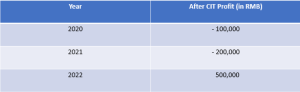
I. Accumulated Net Profit = 500,000 – 100,000 – 200,000 = 200,000
II. Company Reserve Funds 10% = 200,000 * 10% = 20,000
III. Repatriable Profit = 200,000 – 20,000 = 180,000
IV. Withholding Tax (10%) = 180,000 * 10% = 18,000
V. Dividends received by Parent Company = 180,000 – 18,000 = 162,000